

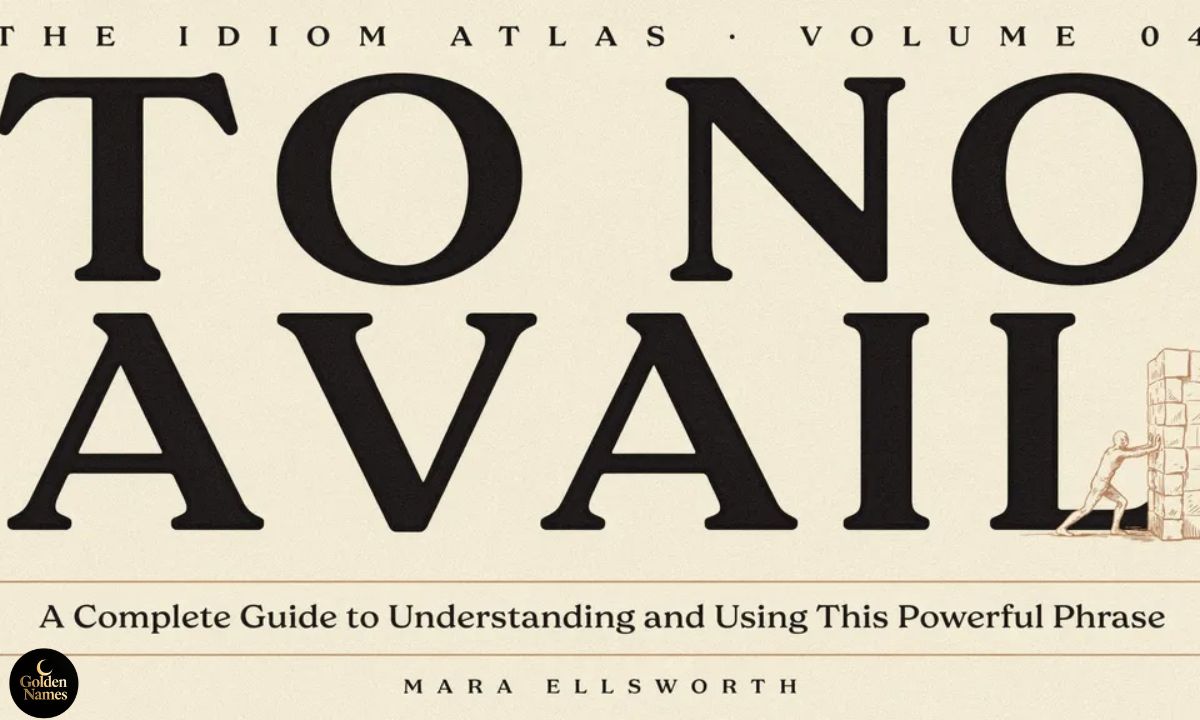
When you’ve tried everything possible to solve a problem, but nothing worked, you might find yourself searching for the right words to describe that frustration. This is where the phrase “to no avail” comes in perfectly. It’s one of those expressions that captures a whole experience in just four simple words, the feeling of effort without results, of attempting without achieving.
Whether you’re writing a professional email, crafting a story, or simply trying to communicate more effectively, understanding this phrase can add nuance and clarity to your language. In this guide, we’ll explore what “to no avail” really means, how to use it correctly, and why it matters in modern communication.
What Does “To No Avail” Actually Mean?
At its core, “to no avail” means that something was attempted but produced no positive outcome. It describes a situation where effort was made, but the desired result didn’t happen. The word “avail” comes from Latin and means benefit, advantage, or use. So when you do something “to no avail,” you’re essentially saying it provided no benefit or usefulness.
Think of it this way: if you try to push a broken car out of a ditch, but it won’t budge no matter how hard you push, your effort has been made “to no avail.” The action happened, but it didn’t accomplish its purpose. It’s not about something being easy or hard—it’s about whether the attempt actually worked.
The phrase carries a specific emotional weight too. It suggests not just failure, but futility. There’s often an undertone of disappointment, resignation, or irony when someone uses this expression. It acknowledges that real effort was invested, which makes the failure more poignant.
The Origin and History of “To No Avail”
Understanding where a phrase comes from can help you appreciate it better. The word “avail” has been part of English for centuries, borrowed from Old French “avallier,” which meant to be of value or to matter. By the time English speakers adopted it, “avail” had settled into meaning usefulness or benefit.
The specific phrase “to no avail” became particularly popular during the medieval and Renaissance periods, though the concept existed before then. Writers and poets embraced it because it was both economical and expressive. Instead of saying “we made efforts, but they didn’t help us achieve our goals,” you could simply say “our efforts were to no avail.”
In modern English, the phrase remains common, though fewer people use it in everyday casual conversation compared to a century ago. Today, you’re most likely to encounter it in written contexts—literature, journalism, formal communication, and online content. Its relative formality gives it gravitas, which is why it persists despite simpler alternatives being available.
How to Use “To No Avail” in Your Writing and Speech
Using this phrase correctly is straightforward once you understand its structure. It’s an idiomatic expression that functions as an adverbial phrase, meaning it modifies a verb or describes how an action was performed.
The basic formula is: [Subject] [tried/attempted/worked/etc.] + [to no avail]
Here are some correct usage examples:
- We called the help desk multiple times to no avail.
- Despite her best efforts to no avail, she couldn’t convince the committee.
- He searched everywhere to no avail for his missing keys.
One thing to note: “to no avail” typically comes at the end of a clause or sentence, though it can sometimes be positioned earlier for stylistic effect. The phrase works best when there’s a clear action or effort mentioned beforehand. If someone reads “to no avail” without context, they won’t fully understand what effort failed.
You can also use it with other structures:
- His attempts were to no avail.
- To no avail, she protested the decision. (less common, but grammatically correct)
- The warning signs were to no avail in stopping the disaster.
Real-Life Examples and Practical Scenarios
Let’s look at how this phrase appears in actual situations to understand its proper use.
In Business Communication: We reached out to three vendors, but to no avail—none of them could meet our timeline. Here, the phrase succinctly explains that contact was made but produced no useful results.
In Problem-Solving: “I tried restarting the computer, updating the software, and clearing the cache, but to no avail. The error persisted. This shows multiple attempts, all unsuccessful.
In Personal Stories: “Years of therapy and medication helped, but my childhood trauma proved resistant to treatment to no avail.” The phrase emphasizes the persistence of a problem despite comprehensive efforts.
In Historical or News Contexts: “Firefighters worked through the night to no avail as the historic building burned to the ground. This usage highlights the tragedy of effort without success.
In Academic Writing: “Previous studies attempted to establish this correlation to no avail, which motivated our research. Here, it summarizes earlier unsuccessful attempts in a sophisticated way.
The beauty of “to no avail” is that it works across formal and less formal contexts, though it tilts toward the more serious and intentional side of communication.
Similar Phrases and Helpful Synonyms
If “to no avail” feels too formal for your needs, several alternative phrases express the same idea with slightly different tones.
Without success The most direct modern alternative. “We tried to reach her without success.It’s neutral and clear, commonly used in both written and spoken English.
In vain Nearly identical in meaning and formality level. “Our protests were in vain. Both phrases share the same Latin roots and are often used interchangeably.
To no effect Slightly less formal than “to no avail.We complained to no effect. It emphasizes lack of impact more than lack of benefit.
For nothing Informal and conversational. I spent hours preparing for nothing. This phrasing is more emotional and less precise.
Without avail Technically correct but rarely used in modern English. You might encounter it in older texts or very formal writing.
Unsuccessfully The simplest alternative. “She tried unsuccessfully to reach him. It’s direct but lacks the subtle sense of futility that “to no avail” carries.
All in vain Emphasizes wasted effort. “The hours spent studying proved all in vain. This variant is slightly more emphatic.
Each alternative carries its own subtle flavor. “To no avail” stands out for its sense of dignity in defeat, it acknowledges effort and attempts honestly, without being overly dramatic.
Formal Versus Informal Usage: When to Use This Phrase
Context matters enormously when choosing whether to use “to no avail.” This phrase isn’t equally appropriate in all situations.
Use “to no avail” when:
- Writing professionally or academically
- Crafting a formal letter or email
- Telling a serious story where dignity matters
- Creating narrative tension in fiction
- Writing journalism or technical documentation
- Speaking in formal presentations or debates
Avoid using “to no avail” when:
- Texting friends casually
- Writing very informal social media posts
- Speaking off-the-cuff in relaxed conversations
- Creating deliberately light or humorous content
In casual contexts, saying “It didn’t work” or “Nothing happened” feels more natural. If you force “to no avail” into an overly casual setting, it might sound pretentious or disconnected from your actual voice.
That said, the phrase is becoming slightly less formal over time as language naturally evolves. You’ll see it used more frequently in contemporary online writing than you would have ten years ago, particularly in professional blogs, thoughtful social media posts, and digital journalism.
The key is matching your language to your audience and purpose. A formal business email benefits from “to no avail.” A group chat message doesn’t.
Common Mistakes People Make With This Phrase
Even though “to no avail” is fairly straightforward, people sometimes use it incorrectly or awkwardly.
Mistake 1: Using it without a clear action Wrong: “She wanted a promotion to no avail. Better: “She applied for the promotion multiple times to no avail.” The improved version shows actual effort before the failure.
Mistake 2: Overusing it in short passages Having “to no avail” appear twice in a single paragraph feels repetitive. One usage per longer text section usually works best.
Mistake 3: Assuming readers understand the implied attempt Sometimes writers use the phrase expecting the audience to know what effort was made, but the context isn’t clear. Always ensure the attempted action is obvious or recently mentioned.
Mistake 4: Mixing it awkwardly with contractions or very casual language “I texted him like a million times to no avail” – This mixing of registers (very casual language with formal phrase) can feel jarring. Choose one tone and stick with it.
Mistake 5: Using it when there’s actually partial success “I tried to get them to lower their prices to no avail, but they did offer a discount.” This is contradictory. If they offered something, the effort wasn’t entirely to no avail.
Mistake 6: Spelling or punctuation variations The phrase should always be “to no avail,” not “to no avale” or other variations. It’s also not hyphenated, unlike some similar expressions.
Frequently Asked Questions
Is “to no avail” the same as “in vain
Yes, essentially. Both mean the effort didn’t produce the desired result. “In vain” is equally formal and perhaps slightly more poetic. You can use them interchangeably in most contexts.
Can I use “to no avail” in positive sentences
No, not really. The phrase is inherently about failure or unsuccessful effort. You wouldn’t say “I called him to no avail and he answered.” That contradicts the meaning.
Is this phrase considered old-fashioned
Not outdated, but it is more formal and literary than some alternatives. It appears regularly in modern news, professional writing, and contemporary literature, so it remains current.
Should I use “to no avail” in a resume or job application
You could, in contexts where you’re describing challenges you’ve overcome. Example: “Despite marketing efforts to no avail through traditional channels, I successfully pivoted to digital strategies. It adds sophistication but shouldn’t be forced.
How do I know if my audience will understand this phrase
If you’re writing to educated adults in formal or semi-formal contexts, they’ll understand it. If you’re uncertain, a simpler alternative like “without success” is safer.
Can “to no avail” work in dialogue for fiction
Yes, but only for characters who would realistically speak that way. It works well for formal characters or situations requiring gravitas, but would sound unnatural from a casual speaker.
What’s the best way to remember this phrase
Think of “avail” meaning benefit or help. “To no avail” means “producing no benefit.” Whenever you want to express that effort happened but didn’t help, this phrase fits perfectly.
Conclusion
In an era of constant communication, where we often reach for the quickest, shortest words possible, “to no avail” remains relevant precisely because it does something simple alternatives can’t quite accomplish. It acknowledges effort respectfully while stating clearly that the effort didn’t work. There’s a kind of honesty and maturity in the phrase.
When you say something happened “to no avail, you’re not saying the attempt was worthless, you’re saying it was unsuccessful despite being real. This distinction matters. It validates the effort even as it acknowledges the failure, which is why you often hear this phrase in contexts discussing struggle, persistence, or tragedy.
Whether you’re writing a serious work email, crafting a narrative, or simply trying to express yourself more precisely, understanding and using “to no avail” gives you another tool in your communication toolkit. It’s the kind of phrase that might seem formal at first glance, but when used correctly, it sounds natural, intelligent, and perfectly suited to expressing a universal human experience: trying hard and coming up short.
The next time you’re describing a situation where effort met no success, consider reaching for this phrase. It might just be exactly what your sentence needs.