

Some words exist in the space between ancient faith and everyday conversation. Perdition is exactly that kind of word.
You’ve probably heard it whispered in church sermons, read it in classic novels, or caught it in movie dialogue. But understanding what it truly means, and how to use it confidently in today’s context, is something most people skip ove r. This guide fills that gap comprehensively and clearly.
What Does Perdition Actually Mean
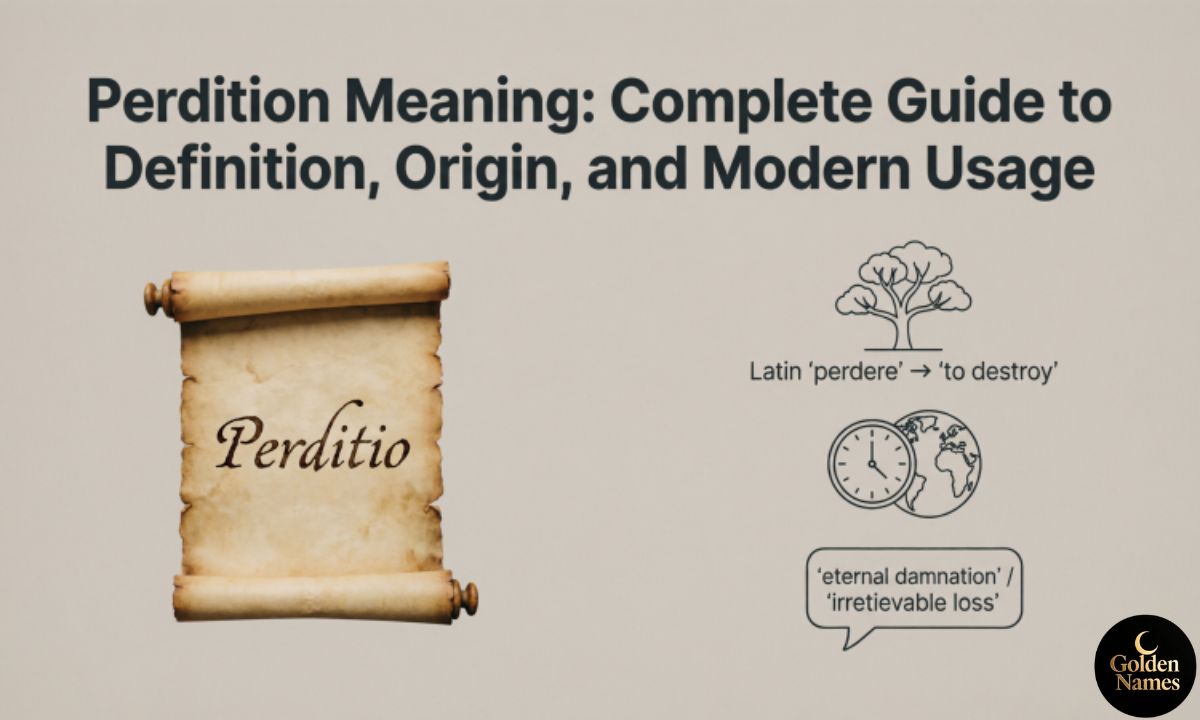
Perdition is a noun pronounced like pur-DISH-un. At its core, it refers to eternal damnation, the theological concept of being condemned to suffer forever after death, separated from divine grace and salvation.
But here’s what makes the word genuinely useful: it works on two distinct levels.
Religiously, perdition describes the ultimate spiritual consequence of sin or moral failure, a permanent state of separation from God and salvation. It’s what religious communities have feared as the worst possible fate for millennia.
Secularly, perdition has evolved into a powerful metaphor for complete and utter destruction. When a business magazine writes about a company sliding into financial perdition, readers immediately grasp that this organization faces ruin with no realistic escape route. When a political columnist warns someone about heading toward perdition, everyone knows something catastrophic is coming.
This duality makes perdition one of those rare words that bridges formal theological discussion and casual modern speech. It carries weight. It conveys finality. And it resonates across different contexts.
The Literal vs. Figurative Split
The literal meaning stays rooted in Christian theology: the state of eternal punishment and damnation after death.
The figurative meaning applies to any scenario involving irreversible loss, complete collapse, or total destruction. Financial perdition. Professional perdition. Moral perdition. The structure remains the same—something has gone so wrong that recovery seems impossible.
Tracing the Word Back: Where Did Perdition Come From
Etymology matters because it shows how language carries meaning through time.
Perdition entered English somewhere around 1300-1350 CE, borrowed from Old French perdiciun. That French word itself came from Latin perditiō, which literally translated to destruction or loss.
Dig deeper into Latin, and you find the verb perdere, built from two powerful components:
- Per- meaning thoroughly or away completely
- Dare meaning to give
So perdere literally means “to give away entirely” or “to destroy utterly. This linguistic DNA explains why perdition carries such finality. It’s not about temporary setback or minor failure. Perdition means complete surrender, total and irreversible loss.
Medieval theologians loved this word because it perfectly captured their understanding of damnation. They weren’t describing a second chance or a potential redemption. They were describing the absolute worst outcome: eternal separation from God.
The Path Through Literature
The word gained cultural staying power through literature. John Milton used it memorably in Paradise Lost to describe Satan’s fate: “Hurl’d headlong…To bottomless perdition, there to dwell. That single phrase, bottomless perdition became iconic in English-speaking culture.
Shakespeare referenced it in Othello, using the term to describe military destruction. Mary Shelley wove the concept throughout Frankenstein, where Victor Frankstein’s scientific ambition leads him toward perdition in a metaphorical sense.
These weren’t accident uses. Classical authors recognized that perdition had gravity. When you use perdition, you’re invoking centuries of literary weight and theological seriousness. That’s why it works so well in both academic and casual writing today.
Perdition in Different Contexts and Communities
Religious and Theological Meaning
In Christian theology, perdition occupies a specific place in spiritual cosmology. It’s the final destination of souls who die in sin without redemption. Related concepts include:
- Gehenna (from Hebrew tradition) a valley associated with burning and punishment
- Tartarus (from Greek mythology, adopted into Christian writing), the deepest, darkest section of the underworld
- The Pit (biblical language) another name for hell itself
A 2021 Pew Research Center study found that approximately 58% of Americans hold some belief in hell, meaning perdition resonates as a meaningful concept for a substantial portion of the U.S. population. For religious communities, particularly evangelical and Catholic traditions, perdition remains a serious theological reality rather than abstract metaphor.
Literary and Academic Use
In scholarly and creative writing, perdition transcends pure theology. Authors use it to express themes of:
- Inevitable destruction stemming from personal flaws
- Moral corruption that leads to irreversible consequences
- Complete failure in pursuit of ambition
- Downfall as the result of defying natural or divine law
When a literary critic describes a Shakespearean villain as rushing toward his own perdition, readers understand both the theological echo and the narrative weight. The word adds gravitas to character analysis.
Contemporary American Usage
Modern American English has embraced perdition in increasingly casual contexts, though it always carries a sense of seriousness.
Political commentary has picked up the word enthusiastically. Columnists warn about policies that lead toward “economic perdition” or describe political movements as heading toward “constitutional perdition.” The word conveys the author’s conviction that something is genuinely catastrophic.
Business writing uses perdition to describe companies facing collapse. You’ll find phrases like “the startup avoided financial perdition through aggressive restructuring” or “without intervention, the pension fund faces actuarial perdition.
Everyday speech occasionally borrows the term for emphasis, though usually with ironic distance: This traffic jam is absolute perdition or That meeting was perdition. Here, speakers use the word’s inherent extremism for humorous effect.
Perdition and Related Words: Building Your Vocabulary
Words That Mean Nearly the Same Thing
Understanding synonyms helps you recognize perdition in different contexts and choose the right word for your own writing:
- Damnation divine condemnation; judgment against someone
- Doom inevitable terrible fate that cannot be avoided
- Hellfire emphasis on the suffering component of punishment
- Downfall sudden loss of power, status, or wealth
- Ruin complete destruction or collapse of something
- Condemnation official judgment of guilt or moral failure
- Inferno intense, uncontrollable destruction (often with fire imagery)
- Destruction the process of being destroyed completely
- Damnation the act or state of being damned
Each of these carries slightly different connotations. Damnation is more explicitly theological. Downfall is more about social or professional collapse. Ruin is more general. But all share perdition’s core idea: something has gone fundamentally, completely wrong.
The Opposite: Words Representing Hope
Understanding antonyms clarifies what perdition means by showing its opposite:
- Salvation rescue from sin; deliverance from damnation
- Redemption being absolved or freed from guilt
- Grace unmerited divine favor and blessing
- Deliverance rescue from danger or evil
- Ascension rising up, particularly spiritually
- Eternal life the reward of righteousness; the opposite of eternal damnation
- Rehabilitation restoration to good condition or standing
- Recovery the process of returning to normal or healthy state
These antonyms aren’t just opposites in meaning, they represent the theological or practical flip-side of perdition’s reality. Where perdition means permanent loss, salvation means permanent gain.
Using Perdition in Sentences: Practical Examples
The best way to truly understand a word is seeing it in action. Here are realistic examples across different contexts:
Religious and Theological Contexts
The preacher warned that unchecked pride was the surest path to perdition, quoting Biblical passages about humility and grace.
Medieval theologians spent centuries debating the nature of perdition and whether it truly was eternal or merely an extended period of punishment.
She described her spiritual crisis as a descent into perdition, until she found meaning again through community service.
Historical and Literary Contexts
Milton’s portrayal of Satan’s fall into perdition influenced how generations of English speakers understood the concept of ultimate failure.
The novel’s protagonist recognizes too late that his obsession with revenge has led him inexorably toward perdition.
That monument stands as a reminder of the civilization that reached toward perdition through arrogance and corruption.
Modern and Professional Contexts
The analyst warned investors that the company’s unsustainable debt load was pushing it toward financial perdition.
Without serious policy changes, the state’s pension system faces actuarial perdition within the next decade.
The political scandal sent his career into perdition almost instantaneously, ending decades of political influence.
Casual and Contemporary Contexts
Rushing through three back-to-back meetings on Friday afternoon while already exhausted, that’s just perdition.
Going on a road trip with no planning, no map, and one gas tank, now that’s a recipe for absolute perdition.
She joked that her teenager’s bedroom had descended into such perdition that she’d stopped trying to find the carpet underneath.
| Common Phrases and Collocations You’ll See |
| Road to perdition • On the brink of perdition • Staring into perdition • Fire of perdition • Cast into perdition • Financial perdition • Bottomless perdition • Edge of perdition • Sliding toward perdition • Path toward perdition |
Perdition Vs. Similar Words: Making Fine Distinctions
While damnation and perdition are closely related, they carry slightly different weights in usage.
Perdition emphasizes the state or condition of being damned, what damnation has created. It’s the actual place or situation you find yourself in after judgment.
Damnation emphasizes the act or process of being condemned. It’s more about the judgment itself than the aftermath.
Similarly, perdition differs from downfall in scope. A downfall might be recoverable or temporary. Perdition, by definition, is permanent and complete.
This distinction matters when you’re choosing words for clarity. If you mean someone is facing ultimate, irrevocable destruction, perdition is perfect. If you mean they suffered a serious defeat but might recover, downfall works better.
Common Misconceptions About Perdition
Misconception 1: Perdition Means Death
Actually, perdition doesn’t mean death itself. It means the state after death, what happens to your soul if you’re condemned. The death is the event. Perdition is the consequence.
Misconception 2: Perdition Only Appears in Old Books
While perdition has classical roots, it appears regularly in contemporary news articles, business writing, and modern discourse. It hasn’t become archaic, it’s remained relevant because it perfectly expresses complete irreversible loss.
Misconception 3: Perdition Is Only Religious
Though it originated in religious context, perdition has become genuinely secular. You can discuss financial perdition, professional perdition, or environmental perdition without invoking any theological framework.
Misconception 4: Using Perdition Sounds Pretentious
When used appropriately and naturally, perdition sounds knowledgeable rather than pretentious. It’s a legitimate English word found in major dictionaries and used by professional writers across industries.
The Adjective Form: Perditious
The adjective form of perdition is perditious, meaning leading toward perdition or causing ruin.
Example: His perditious choices cost the company millions and damaged countless careers.
Example: The novel explores how ambition, left unchecked, becomes a perditious force in human life.
This form is relatively uncommon in modern English, appearing more often in formal, literary, or scholarly contexts than in everyday speech. But it exists, and understanding it deepens your grasp of the word’s full semantic range.
Frequently Asked Questions About Perdition
What’s the difference between perdition and hell
Perdition is more specific. Hell is a place. Perdition is the state of being damned—what hell represents spiritually. You could say perdition is the condition, and hell is where it occurs.
Is perdition the same as eternal damnation
Essentially yes. Perdition means eternal damnation, the permanent separation from divine grace and salvation. The two terms are interchangeable in theological contexts.
Can perdition be used as a place
Traditionally, yes, cast into perdition” treats perdition as a destination. But modern usage often treats it more abstractly: “heading toward perdition” suggests a trajectory or fate rather than a literal location.
What does the phrase “road to perdition” mean exactly
Road to perdition” refers to a path or series of choices that lead toward complete ruin. It suggests that certain actions or decisions are gradually moving you toward catastrophe. The phrase became especially popular in contemporary speech after the 2002 Tom Hanks film.
Is perdition still relevant in 2026
Absolutely. The concept of complete, irreversible loss, whether spiritual, financial, or professional, remains universally relevant. The word perdition perfectly captures scenarios where recovery seems impossible.
Q: Can you use perdition humorously?
Yes, though ironically. Saying “this Monday is absolute perdition” plays on the word’s extreme nature, creating humor through intentional exaggeration. The context makes the tone clear.
The Bigger Picture: Why Perdition Matters Today
In an era when we have dozens of words for failure and loss, why does perdition endure?
Because it does something other words don’t: perdition carries weight. It invokes history. It suggests finality. When you’re trying to describe something that isn’t just bad but fundamentally, completely destroyed with no path forward, perdition captures that with precision and eloquence.
Whether you’re writing about theological matters, analyzing literature, discussing serious professional crises, or simply trying to emphasize how badly something went wrong, perdition gives you a word that readers recognize and respect.
It’s a word with substance. And in our casual, emoji-filled digital landscape, words with substance stand out.
Final Thoughts: Understanding Perdition in Context
Perdition has made the journey from medieval theology to contemporary discourse without losing its power or relevance. Understanding what it means, both literally and figuratively, gives you access to richer, more precise language.
You now know:
- The precise theological meaning rooted in Christian tradition
- The Latin origins showing why the word means complete loss
- The literary history that made it powerful
- The modern applications across different fields
- How to use it naturally and confidently in your own writing
- The related concepts and synonyms that help fine-tune your meaning
From pulpits to business presentations, from classic literature to contemporary news, perdition remains a word that commands attention. And now you understand exactly why it matters and how to use it effectively.
The next time you encounter perdition, whether in reading or in your own writing, you’ll recognize not just its definition, but the centuries of meaning and weight it carries with it.