

You’re texting a friend, and they reply with just XD after your joke. No words. Just those two letters. Is that good? Bad? Are they laughing, or confused, or annoyed?
This tiny combination of letters carries a lot of emotional weight, and using it in the wrong place (or misreading it) can completely change how a conversation feels. Once you understand what XD really means, you’ll never second-guess it again.
Quick Answer
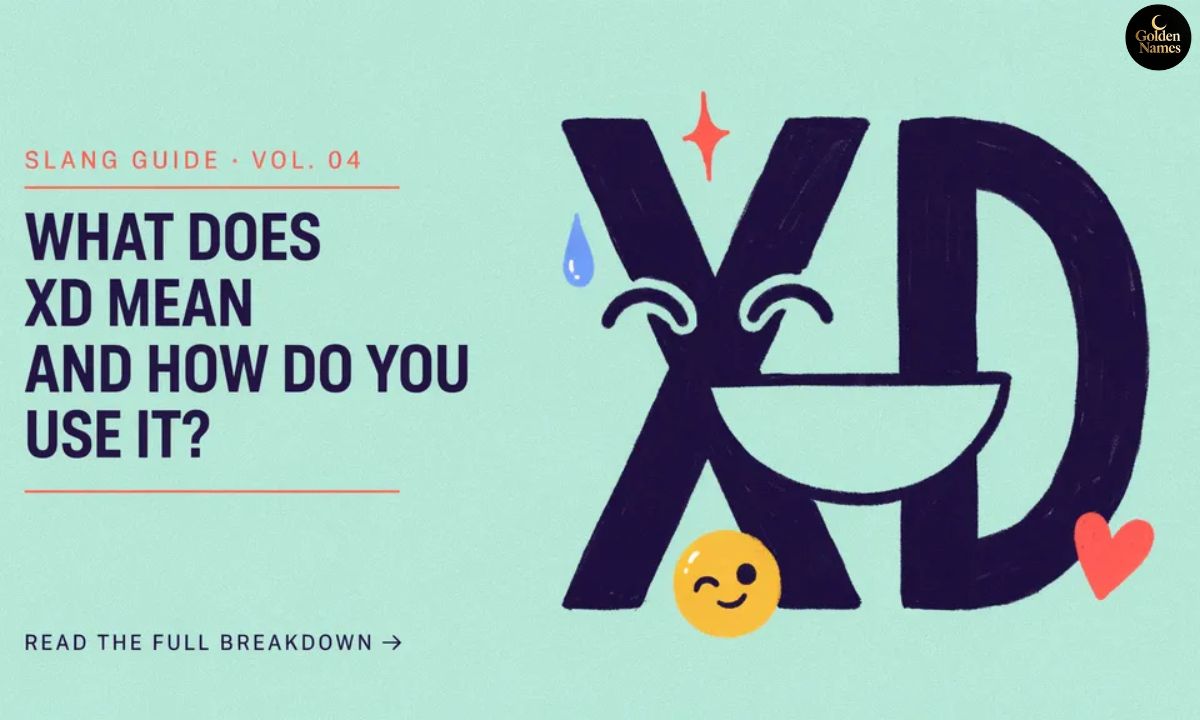
XD is a text emoticon that represents laughing with your eyes squeezed shut and your mouth wide open. The X stands for closed, scrunched-up eyes, and the D stands for an open mouth laughing. It’s used to show that something is very funny, often funnier than a simple haha or lol would suggest. Turn your head sideways and look at the letters XD you’ll see a laughing face. That’s the whole trick to remembering it.
Quick Examples
- ✅ That video of the cat falling off the couch, XD
- ✅ You actually forgot your own birthday XD
- ✅ I just tripped in front of my crush XD kill me
- ✅ lol no way that actually happened XD
- ✅ My dog just ate a whole sock XD I can’t
- ✅ He replied ‘ok’ to a three-paragraph text XD
Simple Rule to Remember
😆 XD = Eyes Shut Tight + Mouth Wide Open = Laughing Hard
Tilt your head to the left, look at the letters X and D, and you’ll see a scrunched, laughing face staring back at you. That’s the whole meaning packed into two characters.
What Does XD Mean?
Definition: XD is an emoticon (a face made from keyboard characters) used in texting, chat, and social media to show that something is extremely funny. It’s read visually, not as a word, and it doesn’t have an official pronunciation the way a regular word does.
Pronunciation: Most people don’t say XD out loud, but when they do, it’s usually said as two separate letters, ex-dee. Some people jokingly pronounce it like a laugh sound, similar to eks-duh, but this is playful rather than standard.
Word origin: XD grew out of the early emoticon culture of internet chat rooms, instant messaging, and online forums in the 2000s. Long before emojis existed as small pictures, people combined punctuation marks and letters sideways to build faces. Classic examples include 🙂 for a smile and 🙁 for sadness. XD followed the same pattern, using capital X for tightly shut, squinting eyes and capital D for a wide-open laughing mouth. It became especially popular in gaming communities, comment sections, and instant messaging apps like MSN Messenger, where fast, expressive reactions mattered more than full sentences.
Common meanings of XD:
- Laughing hard at something funny
- Reacting to something silly, awkward, or ridiculous
- Softening a joke or teasing comment so it doesn’t sound mean
- Expressing amusement at your own mistake
- Showing playful sarcasm or exaggeration
Real-Life XD Examples
Texting and chatting
- ✅ Bro I just called my teacher ‘mom’ XD
- ✅ You really thought pineapple goes on pizza XD
- ✅ I sent that text to the wrong group chat XD
Gaming and online communities
- ✅ I died three times on the tutorial level XD
- ✅ My teammate ran straight into the enemy base XD
- ✅ That was the worst play I’ve ever made XD
Social media comments
- ✅ This meme is too accurate XD
- ✅ Why is this so relatable XD
- ✅ The way he just walked away XD
Everyday situations
- ✅ I locked myself out again XD
- ✅ My alarm didn’t go off and I woke up at noon XD
- ✅ I said ‘you too’ when the waiter said enjoy your meal XD
At a Glance: XD Compared to Similar Reactions
| Expression | Meaning | Tone | Typical Use |
| XD | Laughing hard, eyes shut | Playful, exaggerated | Texting, gaming, memes |
| lol | Laughing out loud (mild) | Casual, low-key | Everyday texting |
| lmao | Laughing my a** off | Strong, informal | Close friends, casual chat |
| 🙂 | Simple smile | Friendly, calm | Polite or neutral messages |
| haha | Genuine laugh | Warm, natural | General conversation |
| ROFL | Rolling on the floor laughing | Very strong, older slang | Older internet forums |
Key Differences Between XD and Other Laugh Expressions
| Feature | XD | lol | lmao |
| Format | Visual emoticon (face) | Acronym | Acronym |
| Read as a face | Yes | No | No |
| Intensity level | High | Low to medium | High |
| Common platforms | Chat, gaming, memes | Texting, general chat | Casual social media |
| Formality | Very informal | Informal | Very informal |
When Should You Use XD?
| If you mean… | Use |
| Something is hilarious and a little chaotic | XD |
| A mild chuckle | lol |
| A genuine laugh out loud | haha |
| Something is embarrassingly funny (yours or someone else’s) | XD |
| A polite, friendly tone | 🙂 |
| Extreme laughter, over the top | lmao or XD |
| A professional or formal message | Avoid emoticons entirely |
| Teasing a friend without sounding mean | XD |
Quick self-check:
- Am I reacting to something silly, awkward, or ridiculous? → XD fits well.
- Am I in a formal email or workplace message? → Skip XD entirely.
Common Collocations With XD
- XD I can’t
- XD kill me
- lol no XD
- that’s so funny XD
- why is this so accurate XD
- I’m dying XD
- this made my day XD
- you’re not wrong XD
- I can’t stop laughing XD
- this is too real XD
Additional Real-Life Examples
- ✅ I forgot I was on mute for ten minutes XD
- ✅ My cat just stared at me for no reason XD
- ✅ I said ‘good morning’ at 4pm XD
- ✅ The teacher called on me and my mind went blank XD
- ✅ I tripped over literally nothing XD
- ✅ My phone autocorrected ‘meeting’ to ‘meowing’ XD
- ✅ I laughed so hard I couldn’t breathe XD
- ✅ This is exactly what happened to me XD
Common Search Queries About XD
Is XD the same as lol? Not exactly. Lol usually shows a light, casual laugh, while XD shows a stronger, more exaggerated laughing reaction. Both mean amusement, but XD carries more energy.
- ✅ That was funny lol
- ✅ That was hilarious XD
Is XD used in texting or gaming more? XD started strong in gaming chat and forums, and it later spread into everyday texting and social media. Today it’s common in both spaces.
Is XD appropriate for work emails? No. Emoticons like XD are considered too casual for professional communication. Stick to plain language or a simple thank-you in work messages.
- ✅ Thanks for your help with the report.
- ❌ Thanks for your help with the report XD
Can XD be used sarcastically? Yes. People often use XD to soften a sarcastic comment or make teasing feel more lighthearted instead of harsh.
Is XD Appropriate for Every Situation?
No, XD is not appropriate everywhere. It fits casual texting, gaming chats, and social media comments, but it doesn’t belong in professional emails, formal documents, or serious conversations about sensitive topics.
| Situation | Appropriate? |
| Texting a friend a funny story | Yes |
| Commenting on a meme | Yes |
| Replying to a work email | No |
| Writing a formal report | No |
| Chatting in a game with friends | Yes |
| Comforting someone going through a hard time | No |
Common Mistakes to Avoid
| Incorrect | Correct | Reason |
| Using XD in a job application | Avoid emoticons entirely | Too informal for professional writing |
| Writing xD and thinking it changes meaning | It’s the same as XD | Capitalization doesn’t change the meaning |
| Using XD to respond to sad news | Use a supportive message instead | XD signals laughter, not empathy |
| Confusing XD with an angry face | XD shows laughing, not anger | The X represents shut eyes, not a frown |
| Overusing XD in every single message | Save it for genuinely funny moments | Overuse weakens its impact |
| Using XD in academic writing | Use plain, formal language | Emoticons don’t belong in academic work |
| Thinking XD is a real word | It’s a visual emoticon, not a word | It should be read sideways as a face |
| Using XD with strangers in formal settings | Use polite, neutral language | XD can come across as too casual |
Variations of XD You’ll See Online
- xD same meaning, just lowercase x
- XDD / XDDD used for extra emphasis, showing even harder laughter
- Xd less common, but still read the same way
- X’D sometimes used to suggest laughing until tears form
- XP a related emoticon with a stuck-out tongue, showing playful teasing rather than laughter
Why Do People Get Confused About XD?
It looks like a math expression. Written outside of a chat context, XD can look like a variable multiplied by another letter, which confuses people unfamiliar with texting slang.
It has no spoken pronunciation. Since XD is meant to be seen, not said, people unfamiliar with emoticons don’t know how to interpret it at first glance.
Spell-check and autocorrect don’t recognize it. Some messaging apps try to correct XD into something else, which adds to the confusion for new users.
It’s easy to mix up with similar-looking reactions. New texters sometimes confuse XD with 😀 or XP, since all three involve similar letters and symbols.
American vs. British English
There is no difference in spelling or meaning between American and British English for XD. It’s an internet-based emoticon rather than a traditional word, so it isn’t tied to regional spelling rules the way words like colour or color are. English speakers everywhere use XD the same way, mainly in casual digital communication.
Easy Memory Trick
😆 Tilt your head to the left. 👀 The X becomes two squeezed-shut eyes. 😄 The D becomes a wide-open laughing mouth. 🤣 Put them together, and you get a face that’s laughing so hard its eyes are closed.
Mini Quiz
Fill in the blank with XD, lol, or a plain response, based on the situation.
- Your friend sends a video of their dog falling into a pool. You reply: That’s hilarious
- You’re emailing your boss about a deadline. You end with: “Thank you for understanding
- Someone tells you a mildly funny joke. You reply: “haha good one
- You just spilled coffee on your laptop. You text a friend: I’m an idiot
- You’re comforting a friend who is upset. You reply: I’m here for you
- Your gaming teammate makes an embarrassing mistake. You type: bro what was that.
Answers:
- XD
- (no emoticon leave blank)
- lol
- XD
- (no emoticon leave blank)
- XD
Frequently Asked Questions
What does XD mean in texting
XD is an emoticon showing laughter, with the X representing closed eyes and the D representing an open, laughing mouth.
Is XD the same as 😀
They’re similar, but XD suggests harder, more scrunched-up laughter, while 😀 shows a simple open smile without the squinting eyes.
Is XD still used in 2026
Yes, XD is still common, especially in gaming communities, comment sections, and casual texting, even though emoji have become more popular overall.
Does XD mean something bad or angry
No. XD always represents laughing, not anger or sarcasm on its own, though it’s sometimes paired with sarcastic text.
Can you use XD in professional writing
No, XD is too casual for professional or academic writing. Stick to plain, clear language in those settings.
Why do people write XD instead of just laughing emojis
Some people prefer XD because it feels more personal, retro, or expressive than a standard laughing emoji, especially in gaming and chat culture.
Is XD only used by younger people
While it’s popular among younger texters and gamers, people of many ages use XD, especially those who grew up with early internet chat culture.
What’s the difference between XD and lmao
XD is a visual emoticon representing a laughing face, while lmao is an acronym expressing very strong laughter through words rather than an image.
Summary
XD is a simple but expressive way to show that something is genuinely funny, using two letters to form a laughing face when read sideways. It works best in casual settings like texting, gaming chats, and social media comments, where a little extra energy makes a joke land better than a plain lol would.
While XD doesn’t belong in professional emails or formal writing, it’s a natural, harmless way to react to something silly or embarrassing among friends. Once you picture the X as tightly shut eyes and the D as a wide-open laughing mouth, the meaning becomes easy to spot every time you see it.
Actionable Takeaway
Use XD when…
- Something is genuinely hilarious
- You’re texting friends or chatting in games
- You want to soften a teasing comment
- You’re reacting to your own embarrassing moment
Avoid XD when…
- Writing a professional email
- Comforting someone who is upset
- Writing formal or academic content
- Talking to someone you don’t know in a serious context
Following this simple check will help you use XD naturally and appropriately in every conversation, without ever second-guessing what it means again.