

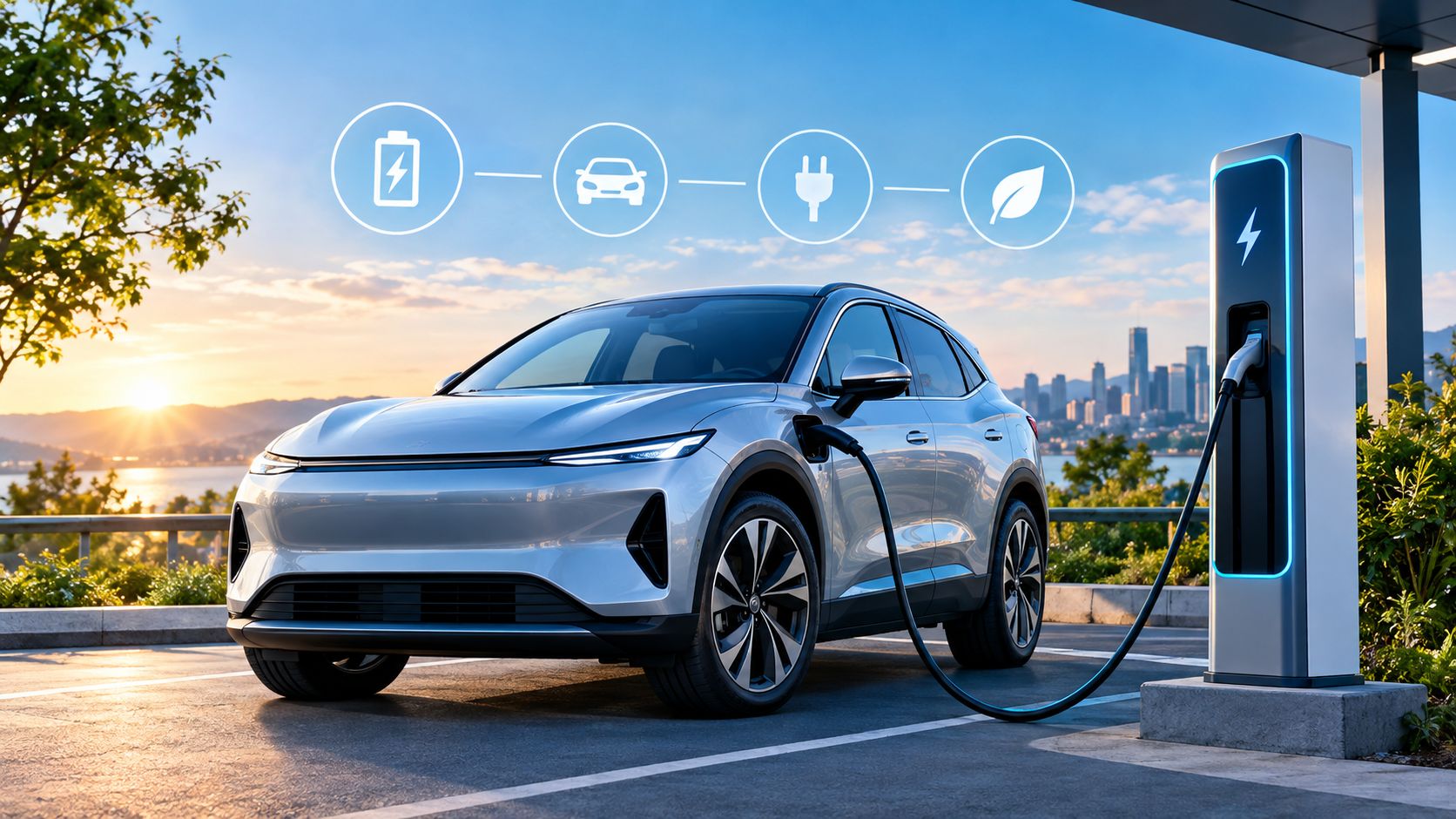
Electric vehicles, commonly called EVs, have moved from being a niche automotive technology to an important part of the modern transportation industry. An EV uses electricity to power an electric motor instead of relying entirely on a traditional internal combustion engine. Depending on the type, an EV may run entirely on electricity or combine an electric motor with a gasoline engine.
For many drivers, the appeal of an EV comes from a combination of quiet operation, instant acceleration, reduced tailpipe emissions, and potentially lower fueling and maintenance costs. However, EV ownership also involves considerations such as charging access, driving range, purchase price, battery technology, and local electricity infrastructure.
The U.S. Department of Energy describes battery-electric vehicles as vehicles powered solely by electric motors using energy stored in rechargeable batteries, while plug-in hybrids combine an electric drivetrain with a conventional engine.
This guide explains what an EV is, how electric cars work, the different types of EVs, charging options, battery technology, advantages and disadvantages, maintenance, range, environmental considerations, and what to look for when choosing an electric vehicle.
What Is an EV?
An EV (electric vehicle) is a vehicle that uses electricity to provide some or all of its propulsion. Electricity is stored in a battery or another energy-storage system and then supplied to an electric motor.
Unlike a conventional gasoline vehicle, a battery-electric EV does not need gasoline or diesel to operate. The motor converts electrical energy into mechanical energy that turns the wheels.
Modern EVs generally contain several important components:
- High-voltage battery pack
- Electric motor
- Inverter and power electronics
- Onboard charger
- Charging port
- Thermal management system
- Regenerative braking system
- Electronic control systems
Battery-electric vehicles have no conventional combustion engine and produce no direct tailpipe emissions while driving. However, emissions can still be associated with electricity generation and the manufacturing and lifecycle of the vehicle.
How Does an EV Work?
An EV works by storing electrical energy in its battery and using that energy to drive an electric motor.
The basic process is straightforward:
- Electricity enters the vehicle through a charging system.
- The battery stores the electrical energy.
- Power electronics regulate electricity flowing from the battery.
- The electric motor converts electrical energy into movement.
- The motor turns the drivetrain and wheels.
- During deceleration, regenerative braking can recover some kinetic energy and return it to the battery.
This system is considerably different from a gasoline engine, which burns fuel to create mechanical power.
One important characteristic of electric motors is their ability to provide strong torque quickly. This contributes to the responsive acceleration many EV drivers experience. EVs can also operate quietly because they do not have the same combustion process and mechanical complexity as traditional engines.
Types of EVs
The term EV can describe several different vehicle technologies. Understanding the differences is important before buying one.
| EV Type | Main Power Source | Plug-In Charging | Gasoline Engine | Runs Fully Electric |
|---|---|---|---|---|
| BEV | Battery + electric motor | Yes | No | Yes |
| PHEV | Battery + electric motor + engine | Yes | Yes | Yes, for limited range |
| HEV | Fuel + electric motor | No | Yes | Usually only briefly/under specific conditions |
| FCEV | Hydrogen fuel cell | No conventional plug-in charging | No | Yes, through electric motor |
Battery Electric Vehicle (BEV)
A BEV, or battery electric vehicle, is the most straightforward type of EV.
It uses:
- A rechargeable battery
- One or more electric motors
- Electronic power controls
- Regenerative braking
There is no gasoline engine. The vehicle must obtain energy primarily by charging its battery from an electrical source.
Current BEV driving ranges vary significantly by vehicle and battery configuration. The U.S. Department of Energy's Alternative Fuels Data Center notes that all-electric vehicles generally have ranges that can vary from roughly 150 to 400 miles depending on the model.
Plug-In Hybrid Electric Vehicle (PHEV)
A PHEV combines an electric motor and battery with an internal combustion engine.
It can be plugged into an external electricity source, allowing the driver to complete some journeys using electric power alone. Once the battery's usable electric range is depleted, the vehicle can use its gasoline engine.
The AFDC states that many PHEVs can travel approximately 20 to 40 miles on electricity alone, although actual range varies by model.
PHEVs can be useful for drivers who want electric driving for shorter daily trips but still need gasoline-powered range for longer journeys.
Hybrid Electric Vehicle (HEV)
A conventional hybrid is often grouped with electric-drive vehicles but is different from a plug-in EV.
An HEV cannot normally be plugged into an external charger. Instead, its battery is charged primarily through regenerative braking and the vehicle's engine.
This makes an HEV different from a BEV and PHEV.
Fuel Cell Electric Vehicle (FCEV)
Fuel cell electric vehicles use hydrogen to generate electricity through a fuel cell. That electricity powers an electric motor.
FCEVs are therefore electric-drive vehicles, but they store energy differently from battery-electric cars. Their availability depends heavily on hydrogen infrastructure.
EV Charging Explained
Charging is one of the biggest differences between owning an EV and a gasoline vehicle.
Instead of visiting a fuel station every time energy is needed, EV owners can often charge at home, at work, or at public charging stations.
Charging speed depends on factors such as:
- Charger type
- Vehicle charging capability
- Battery size
- Battery state of charge
- Temperature
- Electrical supply
- Charging station output
The U.S. Department of Energy identifies Level 1, Level 2, and DC fast charging as major charging categories.
| Charging Type | Typical Use | General Characteristics |
|---|---|---|
| Level 1 | Home | Slowest; convenient for overnight charging |
| Level 2 | Home, workplace, public | Faster AC charging |
| DC Fast Charging | Public stations | Much faster charging for longer trips |
Level 1 Charging
Level 1 charging generally uses a standard household electrical outlet.
It is the simplest charging option and can be useful for drivers who have modest daily mileage and plenty of time to charge.
According to the Department of Energy, Level 1 charging can provide approximately 2–5 miles of range per hour, depending on circumstances.
Level 2 Charging
Level 2 charging provides substantially more power than basic household charging.
It is commonly used for:
- Home EV chargers
- Workplaces
- Shopping centers
- Hotels
- Public charging locations
For drivers who regularly use an EV, Level 2 charging can be a practical home solution because the vehicle can recharge during periods when it is parked.
DC Fast Charging
DC fast chargers are designed for situations where drivers need significantly more energy in a shorter period.
They are particularly useful for:
- Highway travel
- Long-distance road trips
- Commercial fleets
- Drivers without convenient home charging
Actual charging time varies considerably depending on the vehicle, charger, battery temperature, battery state of charge, and other technical factors. Therefore, advertised charging times should always be checked against the specific vehicle and charging equipment.
EV Battery Technology
The battery is one of the most important components of an electric vehicle.
Modern EV batteries are rechargeable energy-storage systems designed to provide enough power for propulsion while also meeting requirements for safety, durability, performance, and thermal management.
Battery capacity is commonly expressed in kilowatt-hours (kWh).
A larger battery can provide more stored energy, but battery size is not the only factor determining driving range. Vehicle efficiency, weight, aerodynamics, tires, weather, speed, and driving style also matter.
What Affects EV Range?
An EV's range can change depending on driving conditions.
Important factors include:
- Highway speed
- Aggressive acceleration
- Cold or hot weather
- Cabin heating and cooling
- Heavy loads
- Tire condition and pressure
- Hills and steep roads
- Traffic conditions
- Driving habits
The AFDC notes that extreme temperatures can reduce range because additional battery energy may be required for heating or cooling the cabin. It also notes that rapid acceleration, heavy loads, and significant inclines can reduce range.
This means the official range figure should be viewed as a useful comparison number rather than a guarantee for every journey.
What Is Regenerative Braking?
Regenerative braking is one of the defining technologies in many EVs.
During conventional braking, some of the vehicle's kinetic energy is converted into heat through friction. Regenerative braking instead allows the electric motor to operate in a way that captures some of that energy and sends it back toward the battery.
In simple terms:
Vehicle movement → electric motor acts as a generator → electrical energy recovered → battery
Regenerative braking can improve efficiency and also reduce reliance on conventional friction brakes.
Some EVs allow drivers to select different levels of regenerative braking. Depending on the vehicle, stronger regeneration can create a driving experience where releasing the accelerator causes significant deceleration.
Benefits of EVs
EVs offer several potential advantages over conventional gasoline-powered vehicles.
1. No Tailpipe Emissions for BEVs
Battery-electric vehicles produce no direct exhaust or tailpipe emissions during operation. This is one reason they are classified as zero-emission vehicles at the point of use.
However, this does not mean an EV has zero environmental impact. Electricity generation, battery manufacturing, mining, transportation, and vehicle production all have environmental footprints.
2. Potentially Lower Energy Costs
Electricity can provide a different fueling cost structure from gasoline or diesel.
Actual savings depend on:
- Local electricity prices
- Gasoline prices
- Vehicle efficiency
- Annual mileage
- Charging habits
- Public charging costs
Home charging can be especially convenient because drivers can add energy while the vehicle is parked.
3. Lower Routine Maintenance
BEVs have fewer mechanical components associated with conventional combustion engines.
For example, a BEV does not require routine engine oil changes because it does not have a conventional engine lubricated by engine oil.
EVs still require maintenance, including tires, brakes, suspension components, cooling systems, and other vehicle-specific service items.
4. Quiet Driving Experience
Electric motors can operate very quietly compared with combustion engines.
This can make urban driving more comfortable and reduce the mechanical noise associated with traditional powertrains.
5. Instant Electric Motor Response
Electric motors can provide torque quickly, producing responsive acceleration.
This is one reason even relatively practical electric cars can feel very different from traditional vehicles.
Disadvantages and Limitations of EVs
EVs are not perfect for every driver.
Higher Upfront Cost
Some EVs have higher purchase prices than comparable conventional vehicles. The total financial picture can change when fuel, maintenance, incentives, financing, depreciation, and ownership period are considered.
The right comparison is therefore not simply the sticker price.
Charging Availability
Drivers without home or workplace charging may depend more heavily on public charging infrastructure.
This can be an important consideration for apartment residents or people who regularly travel through areas with limited charging options.
Charging Takes Longer Than Refueling
Even fast charging generally requires more planning than filling a gasoline tank.
For long journeys, drivers should consider charging locations, expected charging time, weather, traffic, and the vehicle's actual range.
Range Can Change With Conditions
Cold temperatures, hot weather, high speeds, hills, heavy loads, and aggressive acceleration can all influence energy consumption.
Battery Replacement Concerns
The battery is a major component of an EV, so long-term battery health is an important consideration when buying a new or used vehicle.
However, buyers should avoid assuming that every EV battery will need immediate replacement after a fixed number of years. Battery durability depends on vehicle design, usage, thermal management, charging behavior, climate, and other factors.
EV vs Gasoline Car
For many buyers, the most useful comparison is between an EV and a traditional gasoline vehicle.
| Factor | EV | Gasoline Vehicle |
|---|---|---|
| Primary energy | Electricity | Gasoline/diesel |
| Tailpipe emissions | None for BEV | Yes |
| Refueling/charging | Charging | Fuel station |
| Home energy option | Yes, where suitable | Generally no |
| Engine oil changes | Not required for BEV | Required |
| Driving noise | Generally quieter | Generally louder |
| Long-distance refueling | Requires charging planning | Usually quick and widely available |
| Energy efficiency | Generally high | Lower than electric drive |
| Range sensitivity | Weather and speed can matter significantly | Also affected by driving conditions |
The Department of Energy reports that EVs can offer substantially better energy efficiency than conventional vehicles and can have lower fueling and maintenance costs, although actual ownership economics vary by vehicle and location.
EV Maintenance: What Owners Should Expect
An EV does not mean a maintenance-free vehicle.
Owners may still need to inspect or replace:
- Tires
- Brake components
- Windshield wipers
- Cabin air filters
- Coolant or thermal-management components
- Suspension parts
- 12-volt battery
- Other vehicle-specific components
One advantage is that BEVs eliminate many engine-related maintenance tasks.
Regenerative braking can also reduce use of friction brakes under some driving conditions.
Always follow the manufacturer's service schedule rather than assuming every EV has identical maintenance requirements.
How to Choose the Right EV
Choosing an EV should start with your driving habits rather than the biggest battery or the longest advertised range.
Step 1: Calculate Your Typical Daily Mileage
Think about how far you actually drive on an average day.
If most journeys are short, you may not need an extremely long-range vehicle.
Step 2: Check Your Charging Situation
Ask yourself:
- Can I charge at home?
- Do I have access to suitable electrical power?
- Can I charge at work?
- Are public chargers available along my regular routes?
Charging access can be more important than maximum battery range.
Step 3: Compare Real-World Efficiency
Do not compare vehicles only by battery size.
A smaller battery in a highly efficient vehicle can provide useful range while keeping weight lower.
Step 4: Consider Long Trips
If you frequently travel long distances, research the vehicle's:
- Highway range
- Fast-charging capability
- Charging-network compatibility
- Charging curve
- Navigation and battery preconditioning features
Step 5: Check Local Ownership Costs
Look beyond the purchase price.
Consider:
- Electricity costs
- Insurance
- Maintenance
- Registration
- Financing
- Charging equipment
- Incentives where available
- Expected resale value
Common EV Buying Mistakes to Avoid
Buying Based Only on Maximum Range
More range can be useful, but it can also increase cost and weight.
Choose a range that matches your actual needs.
Ignoring Home Charging
A driver who can charge at home may have a very different ownership experience from someone who relies entirely on public charging.
Assuming Every Charger Is Equally Fast
Charging stations have different power capabilities, and vehicles have different maximum charging rates.
Ignoring Weather
Range can change in extreme temperatures. Drivers in very hot or cold climates should account for climate-control energy use when planning trips.
Comparing Only Purchase Prices
The cost of ownership includes more than the initial purchase.
Fuel or electricity, maintenance, insurance, financing, depreciation, and charging equipment can all influence the overall calculation.
Are EVs Better for the Environment?
EVs can reduce direct transportation emissions because battery-electric vehicles produce no tailpipe exhaust.
However, the complete environmental picture is more complicated.
Electricity must be generated, batteries require raw materials, and vehicles require manufacturing. The environmental benefit of an EV therefore depends partly on how electricity is generated and how the vehicle and battery are produced.
Charging an EV with electricity from lower-carbon sources can increase its potential climate benefit compared with charging from more carbon-intensive electricity sources.
Therefore, it is more accurate to say that EVs can significantly reduce certain vehicle emissions, rather than claiming that every EV has zero environmental impact.
The Future of EV Technology
EV technology continues to develop in several areas.
Important areas of development include:
- Higher-energy-density batteries
- Faster charging
- Improved charging infrastructure
- More efficient electric motors
- Better thermal management
- Improved battery recycling
- More affordable EV models
- Better software and route planning
- Bidirectional charging
- Improved battery durability
Charging infrastructure is also expanding. For example, the U.S. Department of Energy's Alternative Fuels Data Center reported more than 60,000 publicly accessible charging stations and more than 162,000 charging ports in the United States in 2024.
The exact availability of charging infrastructure varies significantly by country and region, so buyers should research their local network rather than relying on global figures.
EV FAQs
What does EV stand for?
EV stands for electric vehicle. It generally refers to vehicles that use electricity to power an electric motor. The term can be used broadly, although BEVs and PHEVs are the most common plug-in categories.
Is an EV completely electric?
A battery-electric vehicle (BEV) is fully electric and does not use a gasoline engine. A plug-in hybrid electric vehicle (PHEV), however, combines electric propulsion with a gasoline engine.
How far can an EV travel on one charge?
There is no single answer because range varies by model, battery, driving conditions, speed, temperature, and driving style. Modern all-electric vehicles can have ranges from roughly 150 to 400 miles depending on the model.
How long does it take to charge an EV?
Charging time depends on the vehicle, battery, charger power, battery state of charge, and temperature. Level 1 is slow, Level 2 is faster, and DC fast charging can add substantial range much more quickly.
Are EVs expensive to maintain?
EVs still require maintenance, but BEVs generally have fewer engine-related components and do not require conventional engine oil changes. Tire, brake, suspension, cooling, and other maintenance requirements remain.
Do EV batteries wear out?
EV batteries can lose usable capacity over time, just as rechargeable batteries in other products age. Battery life depends on chemistry, thermal management, usage, charging behavior, climate, and vehicle design.
Are EVs good for long-distance travel?
They can be. The experience depends heavily on the vehicle's range, fast-charging capability, charging-network availability, weather, and trip planning.
Should I buy an EV or a hybrid?
It depends on your driving and charging situation. A BEV can be attractive if you have convenient charging and want fully electric driving. A PHEV or conventional hybrid may be more suitable if charging access is limited or you frequently need long-distance flexibility.
Final Thoughts on EVs
The EV is more than simply a car without a gasoline engine. It represents a different approach to transportation built around batteries, electric motors, software, charging infrastructure, and energy efficiency.
For the right driver, an EV can provide quiet operation, responsive performance, convenient home charging, lower routine maintenance requirements, and reduced direct tailpipe emissions. At the same time, buyers need to consider charging availability, purchase cost, driving range, weather, long-distance travel, and local electricity infrastructure.
The best EV is not necessarily the one with the largest battery or the longest advertised range. It is the vehicle that fits your daily driving needs, charging situation, budget, and long-term ownership plans.
As battery technology, charging infrastructure, and electric drivetrain efficiency continue to develop, EVs are likely to remain an important part of the changing automotive landscape.