

Someone texted you “habibti” and your stomach did a little flip. Or maybe you heard it in a song on repeat and finally got curious enough to look it up. Either way, you landed in the right place.
Habibti is one of those words that travels fast. It shows up in Arabic pop songs, in TikTok comment sections, in voice notes from someone you’re falling for. And once you hear it, you want to know exactly what it means, who’s allowed to say it, and whether it’s okay to say it back.
This guide covers all of that. The definition, the pronunciation, the grammar rules, the cultural context, and the everyday situations where habibti shows up. No fluff, no guessing. Just a clear, complete answer.
What Does Habibti Mean
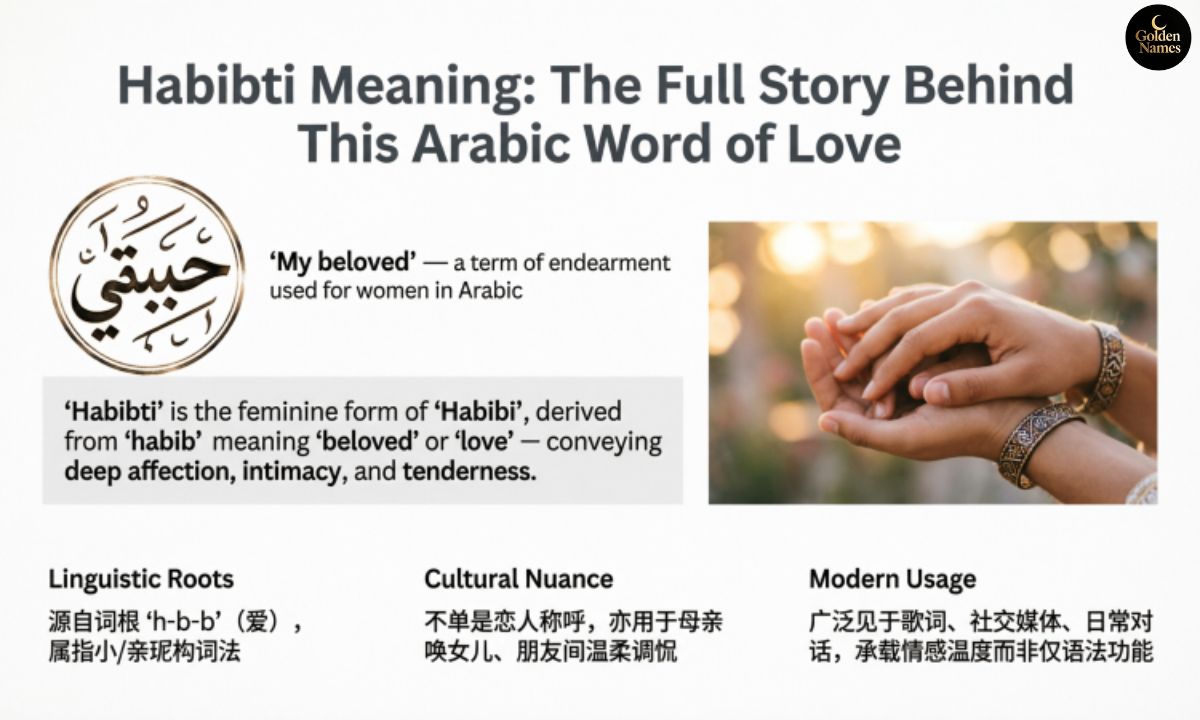
Habibti (حبيبتي) is an Arabic word that means my beloved, my darling, or my dear. It’s used when speaking to a female, whether that’s a romantic partner, a close friend, a sister, or a daughter.
The word carries warmth. It’s not formal, and it’s not neutral. When someone calls you habibti, they’re telling you that you matter to them in a personal, affectionate way.
In English, you’d land somewhere close to “sweetheart, honey, or my love. None of those translations are perfect, because Arabic terms of endearment carry a slightly different emotional texture than their English counterparts. But they get you close enough to understand the feeling behind the word.
Breaking Down the Word Itself
Arabic words build outward from a three-letter root, and habibti is a great example of how that works.
The root is ḥ-b-b (ح-ب-ب), and it means love. From that single root, Arabic generates a whole family of related words:
- Hubb (حُبّ) love, as a noun
- Habib (حبيب) beloved, used for a male
- Habiba (حبيبة) beloved, used for a female
- Habibi (حبيبي) my beloved (male)
- Habibti (حبيبتي) my beloved (female)
That last syllable, -ti, is doing real work. It’s a possessive ending that means my, and it also signals that the person being addressed is female. Swap it out and the whole meaning shifts. This is one reason Arabic feels so logical once you understand the root system. A single sound change can flip gender, ownership, or tense.
How to Pronounce Habibti
If you’ve only ever seen this word written out, the pronunciation can feel tricky at first. Here’s the simple breakdown.
Habibti is pronounced ha-BEEB-tee, with the stress landing hard on the middle syllable.
Say it slowly in three pieces:
- Ha short, like the start of hat
- BEEB long and stressed, rhymes with deep
- Tee quick, like the letter T
You’ll also see it spelled a few different ways online, including habibty, habibtee, and habibati. These are just transliteration differences. Arabic doesn’t use the Latin alphabet, so when people write it out in English letters, spelling varies by personal preference and regional dialect. They all point back to the same word.
Habibti Written in Arabic Script
In Arabic, the word is written حبيبتي, and it reads right to left, which is the opposite direction from English.
If you look closely at the letters, you can actually see the structure we talked about earlier. The body of the word carries the root meaning of love, the ت (ta) near the end marks it as feminine, and the ي (ya) at the very end is the my possessive. Once you know what to look for, the grammar is almost visible right there on the page.
Habibi vs Habibti: What’s the Actual Difference
This is usually the second question people ask, right after “what does it mean. And it’s a good one, because mixing these two up is the single most common mistake non-Arabic speakers make.
The short answer is gender. Habibi is used for a male. Habibti is used for a female. Same root, same warmth, same emotional weight. The only thing that changes is who you’re talking to.
| Word | Arabic Script | Used For | Meaning |
| Habibi | حبيبي | Male | My beloved / my dear (masculine) |
| Habibti | حبيبتي | Female | My beloved / my dear (feminine) |
Why Arabic Grammar Makes This Non-Negotiable
English doesn’t really do this. We say sweetheart or darling to anyone, regardless of gender, and nobody blinks. Arabic doesn’t work that way.
Arabic is a gendered language at almost every level. Nouns, adjectives, even some verbs change form depending on whether you’re referring to something or someone male or female. This isn’t a style choice. It’s baked into the grammar.
So using habibti for a man, or habibi for a woman, isn’t just a small slip. It’s a grammatical mismatch, and depending on the setting, it can come across as a little odd or even mildly disrespectful, the same way calling a man she repeatedly in English would raise eyebrows.
Can a Woman Call a Man Habibi
Here’s where it gets a little more nuanced, and where a lot of quick guides stop short.
Technically, yes. In casual, everyday speech, especially in places like Lebanon and Egypt, some women do use habibi when talking to a man they’re close to. Spoken Arabic is flexible in ways that formal Arabic is not, and regional dialects bend the rules more than textbook grammar would suggest.
But if you want to get it grammatically right and culturally safe, the rule of thumb is simple: match the word to the person you’re speaking to, not to yourself. A woman addressing another woman says habibti. A woman addressing a man says habibi. A man addressing a woman says habibti. A man addressing another man says habibi.
It’s about the listener, not the speaker.
When and How to Use Habibti in Real Life
Knowing the dictionary definition only gets you so far. The real skill is knowing when this word fits naturally and when it doesn’t.
In Romantic Relationships
This is probably the context most people are searching for. Between romantic partners, habibti is tender and intimate, roughly equivalent to calling someone babe or sweetheart in English, but often with a bit more emotional intensity behind it.
A simple text like “Good morning, habibti from a partner is a small, warm gesture. It’s the kind of word that shows up in voice notes, in goodnight messages, in the little check-ins throughout the day. It signals closeness without needing to say I love you outright every time.
Between Friends and Family
Here’s something a lot of people don’t realize: habibti is not exclusively romantic. In Arab culture, it’s used constantly between people who have no romantic connection at all.
You’ll hear it in situations like:
- A mother gently calling her daughter habibti while helping her get ready
- Close female friends greeting each other with habibti before diving into conversation
- An aunt or older relative using it with a younger woman in the family as a sign of affection
In countries across the Levant region, like Lebanon, Jordan, and Syria, this kind of casual, affectionate language between women is extremely common. It’s part of how warmth gets expressed day to day, not something reserved for big romantic moments.
When You Should Avoid Using It
This part matters, especially if you’re new to Arabic culture and don’t want to misstep.
Avoid using habibti with:
- Strangers it can come across as overly familiar or even flirtatious if there’s no existing relationship
- Coworkers or in professional settings emails, meetings, and workplace conversations are not the place for it
- Anyone you’re talking to sarcastically using a term of endearment to mock someone is considered disrespectful in Arabic culture, more so than it might seem in English
A useful comparison for American readers: think about how it would feel if a coworker you’d just met called you sweetheart in a business meeting. Even with zero bad intent, it would feel off. Habibti carries that same kind of weight in the wrong context.
Habibti in Texting and on Social Media
This word has had a real moment online, and it’s worth understanding why.
Arabic pop music has gone global in a major way, and many of the biggest hits lean heavily on words like habibi and habibti in their lyrics and titles. Listeners who don’t speak a word of Arabic still pick up the word from the chorus, then start using it themselves in captions, comments, and texts.
On platforms like TikTok and Instagram, you’ll see habibti used in a few common ways:
- As a caption under a photo with someone close to the poster, romantic or platonic
- In comment sections, often as a playful or affectionate way to address a friend
- In duets and trending sounds tied to Arabic music
There’s also a practical engagement angle here. Posts and captions that include habibi or habibti tend to perform well, likely because the word is short, emotionally loaded, and instantly recognizable even to people who can’t translate it. It reads as warm regardless of language barrier, which is part of why it’s spread so far beyond Arabic-speaking communities.
In texting specifically, it often replaces a longer sentence. Instead of typing hey, I’m thinking about you, someone might just send habibti with a heart emoji. The word does the emotional work on its own.
Habibti Across Different Arab Regions
The core meaning of habibti doesn’t change depending on where you are. But how often it’s used, and in what tone, shifts noticeably by region.
| Region | Countries | Typical Usage |
| Levant | Lebanon, Syria, Jordan, Palestine | Casual and frequent, used freely between friends and family |
| North Africa | Egypt, Morocco, Tunisia | Playful and expressive, often paired with ya as in ya habibti |
| Gulf | UAE, Saudi Arabia, Kuwait, Qatar | More reserved, typically saved for close family or a partner |
In Egyptian Arabic especially, you’ll often hear ya habibti rather than just habibti on its own. That little ya in front is a vocative particle, basically a way of directly calling out to someone, similar to saying oh, my dear” in English. It adds an extra layer of warmth and expressiveness, and it’s extremely common in everyday Egyptian conversation as well as in music and film.
Gulf countries tend to be a bit more conservative with terms of endearment overall, which is consistent with broader cultural norms in that region around public displays of affection. That doesn’t mean the word isn’t used, just that it’s saved for closer, more private relationships rather than thrown around casually.
Habibti and Religious Context
Because Arabic and Islamic culture are so closely intertwined in much of the Arab world, people often wonder whether there’s a religious dimension to this word.
There is, and it’s worth understanding.
Islam places real value on kindness, warmth, and affection within appropriate relationships, and habibti fits naturally into that framework. It’s completely acceptable, and even encouraged, in these relationships:
- Between spouses affectionate language within marriage is supported in Islamic tradition
- Among female family members mothers, sisters, daughters, and other close relatives
- Between close female friends within the general norms of modesty that guide social interaction
Where it becomes more complicated is in romantic or flirtatious use between unrelated men and women outside of marriage. That kind of usage runs against Islamic principles around modesty and appropriate boundaries between the sexes. So while the word itself is warm and welcome in the right relationships, context still matters quite a bit, just as it does in any culture with clear social norms.
Habibti in Urdu and Other Languages
Arabic terms of endearment have influenced language and culture well beyond the Arab world, particularly in South Asian Muslim communities, where Urdu speakers often incorporate Arabic religious and emotional vocabulary into everyday speech.
In Urdu, the closest equivalents to habibti are میری جان (meri jaan, meaning “my life”) and میری عزیز (meri aziz, meaning my dear). These phrases carry a similar emotional register, deep affection paired with a sense of closeness and care.
It’s a small but telling reminder that the impulse behind this word isn’t unique to Arabic. Almost every language has its own version of my beloved or my dear, because the need to express closeness through language is pretty universal. Habibti just happens to be one of the more globally recognizable examples right now, thanks to music and social media.
Other Arabic Terms of Endearment to Know
If habibti doesn’t quite fit what you’re trying to say, Arabic has a deep well of alternatives, each with its own flavor.
Deep, Romantic Alternatives
| Arabic Term | Transliteration | Meaning | Tone |
| حياتي | Hayati | My life | Deeply romantic |
| روحي | Rouhi | My soul | Intense, emotional |
| قلبي | Qalbi | My heart | Romantic and passionate |
| عمري | Omri | My life / my years | Strongly affectionate |
Friendly and Family-Oriented Alternatives
| Arabic Term | Transliteration | Meaning | Best Used For |
| صديقتي | Sadiqati | My friend (female) | Close female friends |
| عزيزتي | Azizati | My dear (female) | Family or close companions |
| نورة | Noura | My light | Affectionate nickname |
If you’re trying to figure out which one fits your situation, here’s a quick way to think about it. For something deeply romantic, hayati or rouhi go further than habibti does. For warm but platonic affection, habibti or azizati work well. And for everyday, low-key warmth, habibti is honestly your safest and most versatile choice across almost any close relationship.
Common Mistakes People Make With Habibti
A few patterns show up again and again when non-native speakers start using this word, so it’s worth flagging them directly.
Using habibti for a man. This is the most frequent mistake. Remember, habibti is feminine. For a male, the correct word is habibi.
Using it with someone you barely know. Even with good intentions, calling a new acquaintance or a stranger habibti can come across as too forward, almost like jumping straight to “honey” with someone you met five minutes ago.
Treating it as purely romantic. As covered earlier, habibti is used constantly in platonic and family contexts. Assuming it always signals romance leads to a lot of unnecessary confusion, especially when someone hears it used between two female friends.
Mispronouncing the stress. Putting the emphasis on the wrong syllable, like saying ha-beeb-TEE instead of ha-BEEB-tee, is a small thing, but it’s noticeable to native speakers and worth getting right if you want to sound natural.
Using it sarcastically. In English, sarcastic use of pet names is common and usually harmless. In Arabic culture, using a term this emotionally loaded in a mocking way tends to land much worse than intended.
Pros and Cons of Using Habibti
If you’re not a native Arabic speaker but want to use the word naturally, it helps to weigh the upsides against the potential pitfalls.
Pros:
- It’s a warm, instantly recognizable way to express affection
- It works across romantic, friendly, and family relationships
- It signals cultural appreciation when used correctly and respectfully
- It’s short, easy to learn, and easy to pronounce once you practice it a few times
- It carries strong emotional resonance, often more so than its closest English equivalents
Cons:
- Getting the gender wrong (habibi vs habibti) is an easy and common mistake
- Using it with strangers or in professional settings can feel inappropriate
- Without cultural context, it can come across as performative rather than genuine
- Regional differences mean the right level of casualness isn’t always obvious to outsiders
- Sarcastic or mocking use can be more offensive than people expect
Frequently Asked Questions
What does habibti mean in English
Habibti translates to my beloved, my dear, or sweetheart in English. It’s the feminine form, used when speaking to a woman, and it expresses warmth, closeness, and affection.
Is habibti only used romantically
No. While it’s common between romantic partners, habibti is also used constantly between mothers and daughters, among close female friends, and by older relatives speaking to younger women. The romantic meaning depends entirely on the relationship and the context.
What’s the difference between habibi and habibti
Habibi is the masculine form, used when speaking to a male. Habibti is the feminine form, used when speaking to a female. The root word and emotional meaning are identical. Only the gender of the person being addressed changes.
How do you say habibti correctly
It’s pronounced ha-BEEB-tee, with the strongest stress on the middle syllable. Breaking it into three parts, ha, BEEB, and tee, makes it easier to get the rhythm right.
Can you use habibti with a friend, not just a partner
Yes, absolutely. It’s a very common way for close female friends to address each other, and it’s also used by family members. It doesn’t automatically imply romance.
Is it disrespectful to use habibti with the wrong gender
It’s not offensive in a serious sense, but it is grammatically incorrect, and a native speaker will likely notice. Habibti should be used for women, and habibi for men, to keep the gender agreement correct.
Why has habibti become popular outside Arabic-speaking countries
Largely through music and social media. Arabic pop songs that use habibi and habibti in their lyrics have gone viral globally, and platforms like TikTok and Instagram have helped the word spread into everyday conversation among people who don’t speak Arabic at all.
Is there a Spanish or Urdu equivalent to habibti
In Urdu, the closest equivalents are meri jaan (my life) and meri aziz (my dear). Most languages have their own version of a deeply affectionate term like this, since expressing closeness through language is a pretty universal human habit.
Final Thoughts
Habibti is a small word that carries a lot of meaning. At its core, it simply means “my beloved” or “my dear” when speaking to a woman, but the way it’s used stretches across romance, friendship, and family in ways that English terms of endearment don’t always capture as neatly.
If you’ve ever been called habibti, or you’re thinking about using it yourself, the most important things to remember are the gender rule, the relationship context, and a bit of cultural respect. Get those right, and this word will land exactly the way it’s meant to: warm, genuine, and personal.