

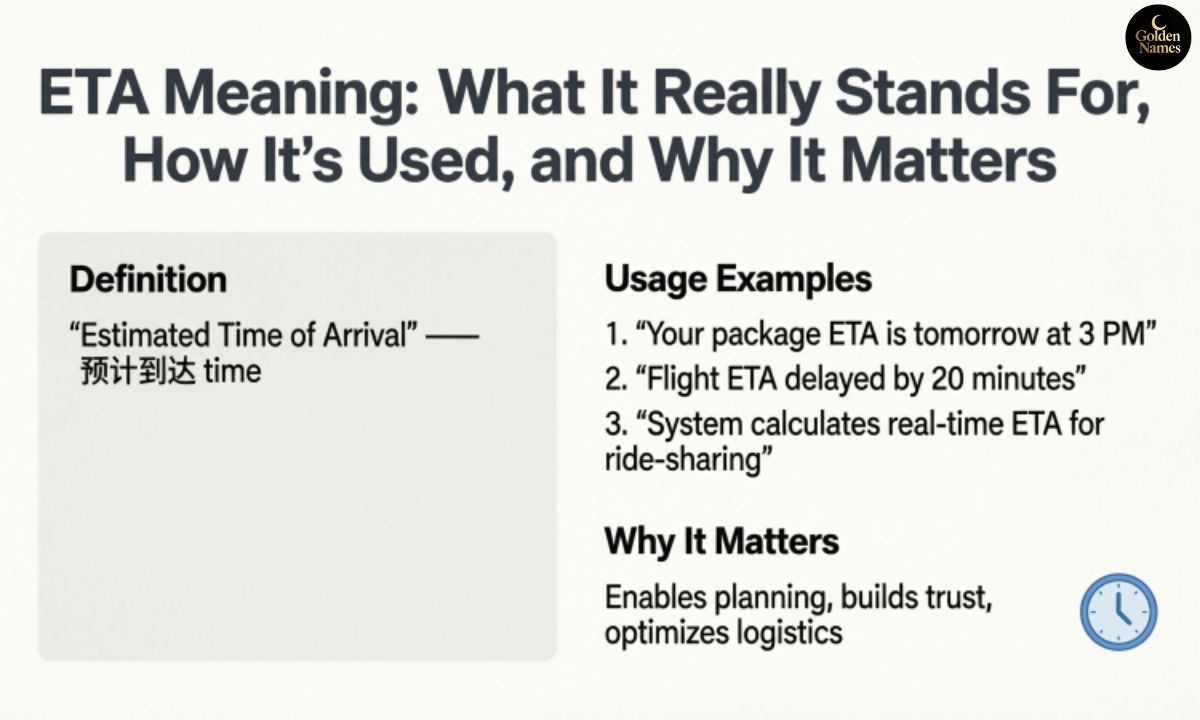
You see it in texts from friends, on shipping confirmation emails, in Uber notifications, and scrawled on sticky notes in warehouse break rooms. Three letters. One universal question behind them all: when does it get here.
ETA is one of those terms that lives comfortably in two completely different worlds, the fast-moving, high-stakes environment of global logistics, and the casual, low-stakes world of texting your friend “hey, what’s your ETA?” Both uses matter. Both deserve a real explanation.
This guide covers everything: the full ETA meaning, where it comes from, how it works across different industries, what it means in texts and social media, common mistakes people make with it, and a lot more in between.
What Does ETA Stand For? The Full Meaning
ETA stands for Estimated Time of Arrival.
That’s it. Three words that together describe a prediction — a calculated best guess of when something or someone will reach a specific destination. The key word in that definition is estimated. Not confirmed. Not guaranteed. Estimated.
This distinction matters more than most people realize, and we’ll come back to it.
ETA applies to almost anything that moves: a container ship crossing the Pacific, a delivery driver two streets away, a colleague running late to a meeting, or a software update rolling out to users. Wherever there’s movement toward a destination, someone is thinking about ETA.
Where Did ETA Come From?
The term has military and naval roots. Before the age of real-time GPS and digital tracking, ships and aircraft needed a standardized way to communicate expected arrival times during missions and operations. “Estimated Time of Arrival” became the standard phrase, eventually shortened to ETA for brevity and clarity in radio communication.
From military use, the term migrated into commercial aviation, then maritime shipping, then land freight, and eventually into everyday language. Today, most people use ETA without knowing it has any kind of formal origin at all.
Is ETA Singular or Can It Change
This trips people up more than you’d think.
An ETA is a snapshot in time based on current information. As conditions change, traffic gets worse, a ship encounters rough seas, a flight gets delayed on the tarmac, the ETA changes too. A single shipment might have several revised ETAs throughout its journey.
That’s normal. That’s expected. A changing ETA isn’t a failure. It’s the system working as intended, updating estimates based on new information.
ETA vs. ATA, ETD, and ATD: Understanding the Full Set
ETA doesn’t exist in isolation, especially in shipping and logistics. It’s part of a family of four timestamp terms that together tell the complete story of a shipment’s journey.
| Term | Full Form | What It Means |
| ETA | Estimated Time of Arrival | When something is expected to arrive |
| ATA | Actual Time of Arrival | When it actually arrived |
| ETD | Estimated Time of Departure | When it’s expected to leave |
| ATD | Actual Time of Departure | When it actually departed |
In practice, the gap between ETA and ATA is one of the most watched metrics in logistics. A carrier that consistently has a wide gap between those two numbers is telling you something important: their ETAs aren’t reliable.
Supply chain teams track this difference to evaluate carrier performance, calculate on-time delivery rates, and identify which routes or lanes tend to cause the most disruption.
ETD vs. ETA: Which One Matters More?
Depends on who’s asking.
A shipper or exporter cares deeply about ETD they need to know when the vessel or truck actually leaves, because that’s what triggers the start of the transit clock.
A consignee or importer cares most about ETA that’s what determines when they need to have their warehouse ready, their customs documentation filed, and their receiving staff scheduled.
Both matter. But they tend to matter to different people for different reasons.
ETA in Texting and Everyday Conversation
Outside of logistics, ETA has become completely embedded in everyday American English. You don’t need to be a freight forwarder to use it. You just need to be waiting for someone.
How ETA Is Used in Text Messages
In texting, ETA is shorthand for when are you getting here? or how long until you arrive? It’s casual, quick, and universally understood.
Real text examples:
- ETA? (That’s the whole message. It works.)
- What’s your ETA? We’re already seated.
- Boss is asking for your ETA on that report.
- ETA on the pizza delivery? I’m starving.
- My ETA is like 20 minutes, traffic is wild.
Notice something? The word estimated doesn’t really carry any weight in these casual uses. When someone texts “ETA?” they don’t mean “please give me a statistically calibrated prediction with confidence intervals. They mean how long?
That’s fine. Language evolves. ETA in texting has become its own informal expression.
ETA on Social Media
On platforms like Twitter/X, Instagram, TikTok, and Reddit, ETA shows up in a few specific contexts:
- Fans asking content creators ETA on the next episode/video/post?
- Sports communities using it during live games or drafts
- Gaming communities asking developers for an ETA on patches or updates
- Event organizers giving followers an ETA for ticket releases or announcements
The context shifts slightly in each case, but the core meaning stays the same: when is this happening?
What Does “No ETA” Mean?
This phrase comes up a lot, and it’s important to understand it correctly.
No ETA means there is no reliable estimate available at this time. It doesn’t mean something is cancelled or definitely delayed indefinitely. It means the situation is uncertain enough that giving a specific time would be misleading.
You’ll see no ETA used by:
- Customer service teams when a service outage has no clear resolution timeline
- Logistics teams when a shipment is stuck in customs with no update from the port
- Developers when a bug fix is being worked on but the scope isn’t yet clear
- Emergency services managing unpredictable situations
It’s an honest answer. Often more honest than a vague ETA that will just get updated again anyway.
ETA Meaning in Different Industries
This is where ETA gets genuinely interesting. The core definition stays constant, but how ETA is calculated, communicated, and acted upon varies significantly from one industry to the next.
ETA in Shipping and Ocean Freight
This is probably where ETA carries the most financial weight. In ocean freight, an ETA for a vessel tells an importer when their goods will be available at the discharge port. Everything downstream warehouse scheduling, customs clearance, trucking bookings, production timelines gets built around that number.
And when it changes? The ripple effects can be significant.
Say a container ship is delayed by four days due to port congestion in Singapore. The consignee’s customs broker had already filed documentation based on the original ETA. The warehouse staff were scheduled. The drayage trucks were booked. Now everything shifts. Last-minute scheduling changes carry extra costs. Sometimes you pay demurrage or detention fees because your truckers couldn’t pick up the container in time.
This is why experienced importers don’t just look at the ETA they want to know how reliable that ETA historically has been for that carrier on that lane.
Port ETA vs. Berth ETA: A Distinction That Costs Money
Here’s something the basic guides skip: there’s a difference between when a ship arrives at a port and when it actually berths (docks and begins unloading).
A vessel can technically arrive at a port and then sit at anchorage waiting, sometimes for days because no berth is available. During that time, the goods are arrived in a narrow technical sense, but you still can’t touch them.
Smart shippers always clarify: they want the berth ETA, not just the port arrival estimate. Knowing when the ship is actually docked and beginning discharge is what drives real operational planning.
ETA in Road Freight and Trucking
In trucking, ETA is often more dynamic because road conditions change constantly. Traffic, accidents, weigh station delays, driver hours-of-service regulations, and weather all affect how quickly a truck gets from point A to point B.
Modern Transportation Management Systems (TMS) and electronic logging devices (ELDs) feed real-time data into ETA calculations, updating them as conditions change. A good TMS doesn’t give you an ETA once at the start of a shipment it gives you a continuously updated prediction throughout the transit.
For warehouse managers, this is huge. Instead of guessing when a truck will show up and keeping the receiving dock staffed all afternoon, they can get alerts when the driver is 30 minutes out and respond accordingly.
ETA in Air Freight
Aviation has the most standardized ETA systems of any freight mode, largely because the air traffic control infrastructure requires it. Every commercial flight has a published ETA at each waypoint and destination, updated continuously by both ground systems and onboard computers.
In air cargo, the ETA is typically more reliable than ocean freight flight times are more predictable than sea voyages. The biggest sources of variation are ground delays, mechanical issues, and transfer logistics at hub airports.
ETA in E-Commerce and Last-Mile Delivery
This is the version of ETA that most consumers interact with every day. The delivery estimate you see on Amazon, Walmart, Target, or any other e-commerce platform is the product of a complex algorithm processing dozens of variables simultaneously.
Factors that influence your delivery ETA:
- Current location of inventory relative to your delivery address
- Carrier capacity and current load
- Time of order placement relative to daily cutoff times
- Day of week and upcoming holidays
- Historical delivery performance on your specific route
- Real-time traffic and weather conditions
Companies like Amazon have trained consumers to expect extremely precise ETAs down to two-hour windows in some markets. When those estimates miss, customers notice and complain. The pressure to maintain ETA accuracy in e-commerce has driven enormous investment in logistics technology.
ETA in Software Development
In tech, ETA is used both internally (within teams) and externally (in communications to users). When a developer says ETA on that feature is end of next sprint, they’re giving a rough timeline estimate for a complex task where many variables are still unknown.
The tension in software ETA estimates is real and well-documented. Developers tend to underestimate task complexity. Product managers push for shorter timelines. Users want features immediately. This creates pressure to give ETAs that are more optimistic than realistic which leads to disappointment when deadlines slip.
A healthy software team treats ETA like a shipping ETA: it’s a current best estimate that may get updated as new information emerges. Not a promise. Not a deadline.
ETA in Emergency and Public Services
First responders, emergency dispatch, and 911 systems all use ETA. When you call for an ambulance, the dispatcher may tell you the ETA for the responding unit. Public transit apps show ETA for the next bus or train. Traffic navigation apps like Google Maps and Waze give an ETA for your destination and update it in real time.
In emergency contexts, ETA isn’t just logistical, it can be genuinely lifesaving information that helps people make critical decisions about what to do while waiting for help to arrive.
What Causes an ETA to Change?
An ETA is a prediction, and predictions are only as good as the information behind them. Here are the most common reasons an ETA gets revised often more than once.
External Disruptions
Weather events are the most common and least controllable cause of ETA changes. Hurricanes, winter storms, fog, and high winds affect every mode of transportation. A winter storm along the I-80 corridor can delay dozens of freight shipments simultaneously.
Port congestion builds when cargo volume exceeds port capacity. This is a slow-developing problem that creates enormous delays. During the supply chain crisis of 2021, vessels sat at anchor outside the Port of Los Angeles for weeks waiting for a berth.
Geopolitical events reshape trade routes overnight. The Houthi attacks on Red Sea shipping in 2024 forced carriers to reroute around Africa’s Cape of Good Hope, adding weeks to ETAs for Europe-Asia shipments and disrupting supply chains globally.
Operational Issues
Customs delays happen when documentation is incorrect, incomplete, or flagged for additional inspection. A single missing field on an import declaration can hold a shipment for days.
Mechanical failures affect vehicles of every type. A truck breakdown, an engine issue on a vessel, or an aircraft mechanical problem all create downstream ETA revisions.
Human error contributes more than most logistics companies admit. Wrong manifests, mislabeled cargo, incorrect routing instructions, these small mistakes can cascade into significant delays.
Systemic Factors
Driver hours-of-service regulations limit how many consecutive hours a truck driver can legally operate. This is a safety requirement, not an obstacle, but it directly affects delivery timelines and has to be factored into ETA calculations.
Seasonal demand spikes, the holiday shipping season being the most obvious example strain carrier capacity and push ETAs out. Carriers get backed up. Terminals get congested. ETAs get revised.
How Companies Improve ETA Accuracy
This is the part that most basic ETA explainers never get to. Knowing what ETA means is useful. Understanding how serious logistics operations try to make ETAs more reliable is genuinely valuable.
Real-Time Shipment Visibility Platforms
The biggest leap in ETA accuracy over the past decade has come from real-time tracking technology. Platforms that integrate with carrier GPS systems, port data, and customs databases give shippers a live view of where their goods are at any given moment.
When you can see exactly where a shipment is — not where it was last scanned, but where it is right now, your ETA calculations become dramatically more accurate.
Predictive Analytics and Machine Learning
Modern ETA systems don’t just track current location. They process historical data, seasonal patterns, weather forecasts, and port performance metrics to forecast disruptions before they happen.
The practical result: instead of learning a shipment is delayed after it’s already happened, a logistics team can receive an alert 48 hours in advance and take action, rerouting the shipment, notifying the customer, or adjusting downstream plans.
That shift from reactive to proactive is the difference between damage control and actual supply chain management.
Better Carrier Communication
ETA accuracy is also a relationship problem. Carriers and shippers who share data in real time rather than relying on email chains and manual updates, consistently achieve better ETA performance.
When a carrier’s system automatically pushes an updated ETA to a shipper’s TMS the moment a delay occurs, both parties can act immediately. When that same update requires a phone call or an email to a specific person who might not check it until Tuesday, the opportunity to respond has often already passed.
ETA Meaning in Slang: Other Uses You Might Not Know
Beyond logistics and casual texting, ETA has picked up a few niche slang uses worth knowing about.
ETA in Gaming
In online gaming communities, ETA is used to ask when a patch, update, content release, or maintenance window will be complete. “ETA on the servers being back up, is a standard question in any gaming community after an unexpected outage.
ETA in Fan Communities
Fandoms use ETA heavily, asking artists, authors, and creators for ETAs on albums, books, episodes, or merch drops. It’s become a standardized way of expressing anticipation without being pushy (usually).
ETA as a Verb (Informal)
In some informal contexts, particularly in American workplace culture, people will say things like “can you ETA me on that, using ETA as a verb meaning give me an estimate.” This is non-standard usage, but you’ll encounter it in fast-paced office environments.
Common ETA Mistakes and Misconceptions
Mistake 1: Treating ETA as a Guarantee
This is the most common and most costly misunderstanding. An ETA is an estimate. The moment you treat it as a firm commitment, you set yourself up for disappointment and frustration every time conditions change, which they always eventually do.
Experienced logistics professionals build buffer time and contingency plans around ETAs for exactly this reason.
Mistake 2: Not Asking for Updated ETAs
An ETA provided at the time of booking or shipment creation is based on information available at that moment. A week later, that information may be completely outdated. Not following up for revised ETAs as a shipment moves through its journey is a common mistake that leads to being blindsided by delays.
Mistake 3: Confusing ETA with Delivery Date in E-Commerce
For online shoppers, the ETA shown at checkout is an estimate based on current conditions. It can change between when you place your order and when your package actually ships. Always check the tracking page for updated estimates rather than relying solely on the number you saw at checkout.
Mistake 4: Assuming “Arrived at Facility” Means Delivered
In parcel tracking, arrived at facility or similar status updates don’t mean the same thing as delivery. The package may still have several steps, sorting, loading onto a delivery vehicle, and the actual last-mile delivery, before it reaches you.
Mistake 5: Giving an ETA When You Don’t Have Enough Information
This one is relevant in professional settings. When someone asks for your ETA on a project, a repair, or a response, the temptation is to give a number even when you genuinely don’t have one. Giving an overly optimistic ETA to avoid an awkward conversation usually creates a worse conversation later. I don’t have a reliable ETA yet but I’ll update you by Thursday is almost always better than a guess that turns out to be wrong.
Pros and Cons of ETA Systems
Like any tool, ETA has both strengths and real limitations.
Benefits of Clear ETA Communication
- Helps customers and stakeholders plan around expected arrival times
- Enables downstream logistics operations (warehouse staffing, customs filing, production scheduling) to be planned in advance
- Allows exceptions and delays to be caught early when tracked against actuals
- Reduces unnecessary follow-up communication (where’s my stuff )
- Creates accountability metrics for carrier performance evaluation
Limitations to Keep in Mind
- ETAs are predictions — they inherit the uncertainty of the inputs used to calculate them
- Over-reliance on a single ETA without monitoring for updates can lead to costly surprises
- In some industries (software, construction, creative work), ETA accuracy tends to be systematically lower because task complexity is harder to predict
- High ETA precision can create unrealistic customer expectations that damage satisfaction when minor delays occur
- ETAs can be gamed, providers may give conservative ETAs to appear to “beat” their estimates
Frequently Asked Questions
What does ETA mean in a text
In a text message, ETA means “when are you arriving or how long until you get there?” It’s casual shorthand borrowed from logistics and transportation. What’s your ETA?” is just a slightly more formal way of saying when are you showing up
What is ETA full form? ETA stands for Estimated Time of Arrival. It’s a prediction of when something or someone is expected to reach a specific destination.
Is ETA the same as delivery date
Not exactly. A delivery date is often a broader window (a day or range of days). An ETA can be more specific — sometimes down to a time window within a day. Both are estimates, but ETA is usually more granular and can update more frequently as a shipment moves.
Why does my ETA keep changing
Because conditions keep changing. Traffic, weather, port congestion, carrier capacity, customs processing times, all of these variables shift continuously, and a well-managed ETA system updates to reflect the new reality. Frequent updates are actually a sign of a good tracking system, not a sign that something is wrong.
What does ETA mean in business emails
In a professional email, asking for an ETA means asking for an expected completion time or delivery time. “Could you provide an ETA on the proposal?” means “when can we expect to receive it?” It’s standard business language.
What is the difference between ETA and ETD
ETA is when something is expected to arrive. ETD (Estimated Time of Departure) is when it’s expected to leave. In shipping, a freight forwarder typically provides both: an ETD from the origin port and an ETA at the destination port.
What does ATA mean compared to ETA
ATA is Actual Time of Arrival, the real, confirmed time something arrived, recorded after the fact. ETA is the estimate made in advance. Comparing ETA to ATA tells you how accurate the estimate was.
What does ETA unknown mean
It means there is no reliable estimate available at this time. The situation is uncertain enough that any number given would likely be misleading. This can happen in customs holds, weather-related delays, or situations where the problem hasn’t yet been diagnosed.
Can ETA be used for people, not just shipments
Absolutely. ETA is used for people, vehicles, packages, software releases, project deliverables, and anything else that’s expected to arrive or be completed at some point. The logistics origin of the term doesn’t limit how broadly it’s used.
What’s a realistic ETA for international ocean freight
Transit times vary enormously by trade lane. China to the US West Coast typically runs 14 to 20 days. China to the US East Coast via the Panama Canal can be 25 to 35 days. Europe to US East Coast is often 8 to 14 days. These are transit times after the vessel departs, total door-to-door times are longer when you add inland transportation, port processing, and customs clearance on both ends.
A Few Real-World Scenarios That Show ETA in Action
Sometimes an abstract definition clicks better with a concrete example behind it.
Scenario 1: The holiday gift that might not make it You order a gift on December 18, and the website shows an ETA of December 23. Two days later, you check tracking and the ETA has shifted to December 26. The carrier is overloaded during the holiday peak. This is a real cost of ETA being an estimate rather than a guarantee, and a good argument for ordering earlier than you think you need to.
Scenario 2: The importer and the tariff deadline A US company importing electronics from Vietnam has a shipment with an ETA of June 14. A new tariff rate takes effect June 20. If the ETA is accurate and customs clears on time, they’ll get the lower duty rate. If there’s a customs delay that pushes clearance past June 20, the additional tariff applies to the whole shipment. ETA accuracy directly determines how much they pay at the border.
Scenario 3: The warehouse manager who trusted an old ETA A distribution center was told a truck would arrive Tuesday. Nobody checked for updates. The truck was delayed Wednesday due to a breakdown and rerouting. The receiving staff was fully scheduled for Tuesday and partially unscheduled for Wednesday. The result: overtime costs, a frustrated driver who had to wait, and a memo from management. One updated ETA check could have prevented all of it.
Scenario 4: The surgeon in the group chat. Your friend group is deciding whether to order pizza now or wait. Someone asks for the ETA of the two people still at the gym. They respond in 20 minutes. Fifteen minutes later they update: Actually 35, couldn’t find parking. This is ETA working exactly as it should, an estimate, updated as real information emerges.
How ETA Relates to Broader Supply Chain Concepts
ETA doesn’t exist in a vacuum. It connects to a broader ecosystem of supply chain metrics and concepts that serious logistics professionals think about together.
Supply chain visibility is the broader goal that ETA tracking serves. The ability to know where your goods are at any point in the journey, and what’s likely to happen next, is what separates reactive supply chains from resilient ones.
Carrier scorecards use the gap between ETA and ATA as one of the primary metrics for evaluating whether a carrier is reliable. A carrier that consistently delivers within the estimated window earns higher ratings and often gets preferred routing.
Safety stock decisions are often influenced by ETA reliability. If you trust your supplier’s ETAs, you can run leaner inventory. If their ETAs are unpredictable, you need to hold more buffer stock to avoid running out, which ties up working capital.
Customer experience in e-commerce is directly tied to ETA accuracy. Research consistently shows that delivery experience, and specifically whether the item arrived when expected, is one of the top factors influencing whether a customer returns to a retailer.
Final Thoughts
ETA is one of those terms that means something slightly different depending on where you are and who you’re talking to. In a freight terminal, it’s a critical operational metric worth real money. In a group chat, it’s a casual question about whether to order appetizers yet.
What stays constant across all those contexts is the underlying question: when?
And the honest answer is almost always the same: based on current information, we think it’ll be around this time, but we’ll let you know if anything changes.
That combination of a best estimate plus the willingness to update it honestly is what ETA, done well, actually looks like. Whether you’re running a global import operation or just trying to coordinate brunch, that’s the idea worth holding onto.