
You’ve probably seen the name Katz on a law firm sign, a deli menu, a museum wing, or maybe a headstone. It’s one of those names that shows up constantly in American life yet most people have never stopped to ask what it actually means or where it comes from.
The answer is genuinely fascinating. Katz is not just a last name. It’s a compressed piece of ancient history that spans priestly lineages in biblical Israel, medieval Germany, the immigration halls of Ellis Island, and even the world of computer science. Four letters. Centuries of meaning.
This guide covers everything the Hebrew roots, the German geography, the medical use, the famous people, and the cultural landmarks that carry this name into the 21st century.
What Does Katz Mean? The Core Definition
Let’s start simple. Katz is a surname a proper noun, not a dictionary word. Pronounced /kæts/ (rhyming with cats), it functions primarily as a family name with two distinct ethnic and geographic origins.
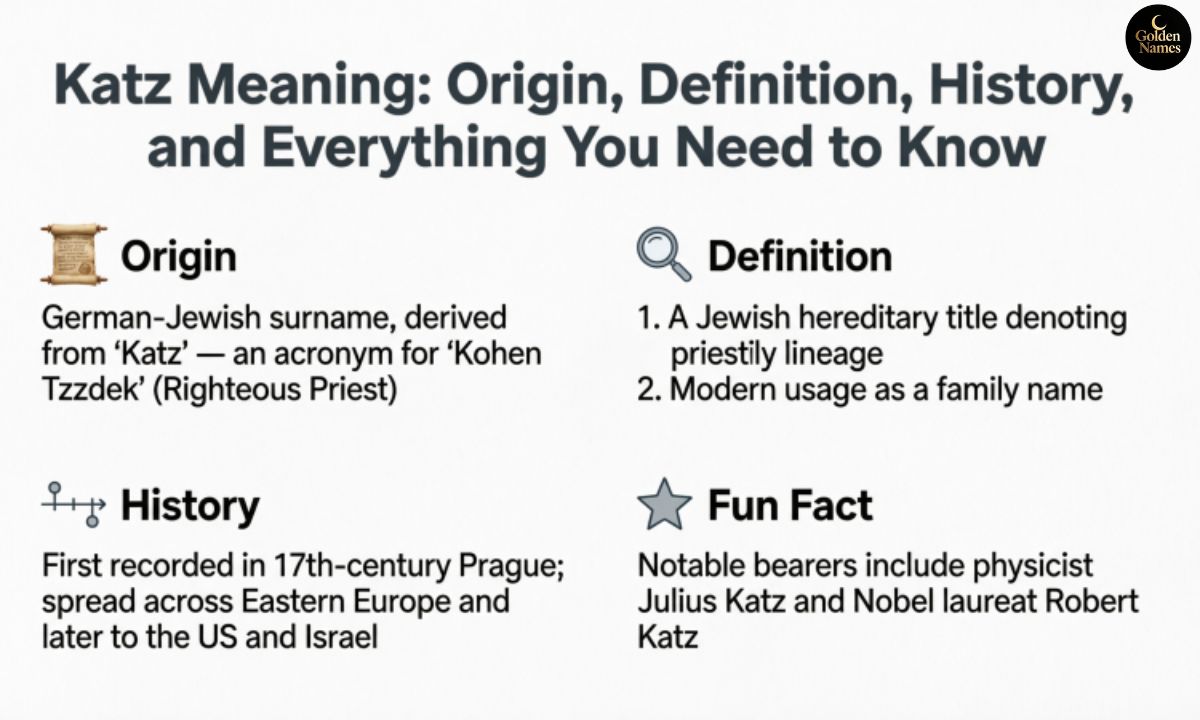
For the majority of people who carry it, especially those from Ashkenazi Jewish families, Katz is a Hebrew acronym. It stands for Kohen Tzedek meaning priest of justice or “authentic priest. The Hebrew letters are Kaf (כ) and Tzaddi (צ), abbreviated as כּ״ץ.
For German families without Jewish heritage, the name carries a different story entirely one rooted in medieval geography along the Rhine River.
Both origins are real. Both are well-documented. And mixing them up is probably the most common mistake people make when researching this name.
Is Katz the German Word for Cat
This question comes up constantly, and it deserves a direct answer: sort of, but not really at least not in the context of the surname.
In everyday German, Katze does mean cat. And Katz looks like a shortened version of that word. But the surname Katz, whether Jewish or German in origin, does not trace back to the animal. The German surname version connects to a place name Katzenelnbogen which has its own separate etymology. The Jewish version connects to the Hebrew priesthood. Neither is about cats.
The Jewish Origin: Kohen Tzedek and the Priestly Lineage
This is where the story gets deep.
In ancient Israel, the Kohanim were the priestly class descendants of Aaron, the brother of Moses. They served in the Temple, performed religious rituals, and held a position of spiritual authority within the community. The role was hereditary, passed through the male line from father to son, generation after generation.
Kohen Tzedek translates as righteous priest or priest of justice. The word tzedek (righteousness, justice) was not just a title decoration. It carried real weight. It described a priest who lived with moral integrity, not just one who performed ceremonies, but one whose conduct matched the sacred role.
Some scholars connect the phrase to Melchizedek, the enigmatic figure in Genesis 14:18 described as “priest of the most high God.” Others trace it to Psalm 132:9, which speaks of priests clothed in righteousness. Either way, the theological grounding runs deep into Jewish scripture.
When Did Katz Become a Formal Surname?
The full title Kohen Tzedek appears in medieval Jewish texts well before it became a family name. Around 917–922 CE, the Gaon of Pumbedita one of the most senior leaders in the Jewish world at the time bore the name Kohen Tzedek Kahana ben Joseph. His son Nehemiah served as Gaon from 960–968 CE. So this phrase was already functioning as a name or title in the 10th century.
The abbreviated form Katz (כּ״ץ) appears on a tombstone in Prague dated 1536 making it nearly 500 years old as a documented written form. A second confirmed use appears on a Frankfurt tombstone from 1618. The name also shows up in a preface written by Shabbethai ben Meir ha-Kohen in Amsterdam in 1663.
As a formal family surname, Katz became widespread during the 18th and 19th centuries. That was when German and Austro-Hungarian authorities began requiring Jewish residents to adopt official last names for legal and tax purposes. Many families who had long identified as Kohanim using Katz as a title or informal identifier officially registered it as their surname.
One important note: not every Jewish family named Katz today can verify documented priestly descent. The name spread widely enough that it became attached to families beyond the original Kohen lineage over the centuries. That said, the priestly connection remains the defining meaning of the name.
Related Jewish Surnames
Katz sits within a cluster of related surnames that all signal priestly or Levitical heritage: Cohen, Kahn, Kagan, Kaplan, Kahan. These names vary by region and dialect but share the same underlying identity descent from, or association with, the ancient priestly tribe of Israel.
Genealogy research consistently shows that Katz families often connect to this broader cluster in family trees, immigration records, and synagogue registries.
The German Origin: Katz Castle and the Rhine River
For families without Jewish heritage who carry the name Katz, the origin story is geographic rather than religious.
Germans with the surname Katz often trace ancestry to the Rhine River region, particularly the territories historically governed by the Counts of Katzenelnbogen a powerful noble family in medieval Germany.
The most famous physical landmark tied to this name is Burg Katz Katz Castle a medieval fortress that still overlooks the Rhine near the town of St. Goarshausen. Built in the late 14th century, it is one of the most photographed castles along the Rhine Valley.
Here’s what surprises most people: the castle’s name has nothing to do with cats. The full name Katzenelnbogen traces back to the Latin term Cattimelibocus a compound word formed from two ancient Germanic elements. The Chatti were a powerful Germanic tribe who inhabited the region, and Melibokus was a prominent mountain in the area. Over centuries, the Latin compound simplified and Germanicized into Katzenelnbogen, which eventually shortened to Katz.
So the German surname Katz is a topographic marker it signals that your ancestors came from, or were connected to, this specific region of Germany. It’s the same naming pattern as families called Rhine, Frankfort, or Bayern.
It’s also worth knowing that some Ashkenazi Jewish families who held the longer surname Katzenelnbogen shortened it to Katz upon arriving in America. This created a kind of convergence both Jewish and non-Jewish bearers ended up with the same short form, though their roots are entirely differ
What Does Katz Mean in Medical Terms?
This is an area most people don’t think about when they search for the name but it matters for a huge portion of American readers.
In clinical medicine, Katz refers to the Katz Index of Independence in Activities of Daily Living, almost always abbreviated as the Katz ADL Scale or simply the Katz Index.
Developed by Dr. Sidney Katz and his team at the Benjamin Rose Hospital in Cleveland, Ohio, the scale was first published in the Journal of the American Medical Association (JAMA) in 1963. It was designed to give physicians, nurses, and caregivers a simple, standardized way to assess how well elderly or recovering patients could manage on their own.
The scale evaluates six basic daily activities:
- Bathing Can the patient bathe themselves without help?
- Dressing Can they choose appropriate clothing and dress independently?
- Toileting Can they use the toilet without assistance?
- Transferring Can they move from bed to chair on their own?
- Continence Do they have control over bladder and bowel functions?
- Feeding Can they feed themselves without help?
Each function is scored, and the total gives clinicians a snapshot of functional independence. It sounds simple, but its predictive power for long-term outcomes made it one of the most widely adopted tools in geriatric medicine worldwide.
If you or a family member has ever been evaluated before discharge from a hospital or before entering long-term care, there’s a real chance the Katz Index was part of that assessment even if nobody mentioned it by name.
Famous People Named Katz
One of the most useful ways to understand what a name means in practice is to look at the people who have carried it. The list of notable Katzes is genuinely impressive across multiple fields.
Science and Medicine
Sir Bernard Katz (1911–2003) is the name that appears in most English-language dictionaries as the primary reference for this surname. Born in Leipzig, Germany, he later became a British citizen and worked as a neurophysiologist and biophysicist. His research into how nerve cells communicate specifically how neurotransmitters are released at the synaptic junction earned him the Nobel Prize in Physiology or Medicine in 1970, shared with Julius Axelrod and Ulf von Euler.
Technology
Phil Katz is less famous by name but his legacy touches everyone who uses a computer. He was the American programmer who created the ZIP file format the compression standard that became the foundation of digital file sharing. Every time you open a .zip file or compress a folder, you are using technology he built.
Art
Alex Katz, born in 1927 in Brooklyn, is one of America’s most significant living painters. His large-scale figurative paintings known for their bold, flat colors and elegant simplicity — hang in major museums worldwide. He has been called a forerunner of Pop Art and continues to work and exhibit actively.
Food and Culture
Sandor Katz, born in 1962, might be the person most responsible for the fermentation revival in American food culture. His books including Wild Fermentation and The Art of Fermentation introduced millions of Americans to practices like making kimchi, sourdough, kombucha, and lacto-fermented vegetables at home. He approaches food preservation as both a health practice and a form of cultural resistance.
Politics
Israel Katz has served in various senior Israeli government roles including Minister of Defense and Minister of Foreign Affairs. Richard Katz served as president of the Los Angeles Board of Water and Power Commissioners and has been involved in major infrastructure decisions affecting Southern California.
Journalism and Media
Evan Ross Katz, a journalist and digital personality, has been credited with helping fuel renewed interest in several pop culture figures through his coverage and social media presence.
Katz in American Culture: From Ellis Island to the Lower East Side
The name Katz has a uniquely American story layered onto its older European roots.
Between roughly 1880 and 1924, millions of Eastern European Jews immigrated to the United States — fleeing poverty, pogroms, and political instability in Russia, Poland, Ukraine, and the Austro-Hungarian Empire. They brought their surnames with them. Katz was already well-established across Ashkenazi communities in those regions, and it traveled well.
Many families arrived at Ellis Island in New York and settled in the dense, Yiddish-speaking neighborhoods of the Lower East Side. The name Katz spread quickly in those communities, showing up on storefronts, synagogue membership lists, and tenement building directories.
Today, according to genealogy records, roughly 52,000 Americans carry the Katz surname, with the highest concentrations in New York, New Jersey, Florida, and California.
Katz’s Delicatessen: A Name That Became an Institution
No discussion of Katz in American culture is complete without talking about Katz’s Delicatessen at 205 East Houston Street in Manhattan’s Lower East Side.
The deli opened in 1888 originally called Iceland Brothers after two immigrant brothers from Galicia who founded it. When Willy Katz arrived in 1903, he joined as a partner. His cousin Benny Katz joined in 1910, and eventually bought out the founders to rename the establishment Katz’s Delicatessen.
For much of the early 20th century, Katz’s functioned as a community anchor for the Jewish immigrant neighborhood that surrounded it. Friday nights meant franks and beans. Families gathered there. Soldiers heading to war got send-off meals there, which inspired the famous wartime slogan: Send a Salami to Your Boy in the Army.
Then came 1989. The film When Harry Met Sally, directed by Rob Reiner and written by Nora Ephron, filmed its most iconic scene inside Katz’s Deli. Meg Ryan’s performance in that scene and Estelle Reiner’s memorable response, “I’ll have what she’s having turned the restaurant into a global pop culture landmark overnight.
Today, the table where that scene was filmed is still marked with a sign. Four presidents have eaten at Katz’s. The deli serves roughly 15,000 pounds of pastrami, 8,000 pounds of corned beef, and 4,000 hot dogs every single week. It remains one of the most visited restaurants in New York City not just for the food, but for what it represents.
In February 2025, Meg Ryan and Billy Crystal returned to Katz’s to film an advertisement for Hellmann’s mayonnaise that aired during Super Bowl LIX more than 35 years after the original scene. The deli is still drawing them back.
How Katz Shows Up in Everyday Language and Online Spaces
Katz as a word has spilled slightly beyond its role as a surname into casual usage especially online.
In meme culture and social media, particularly in communities built around cats, Katz sometimes appears as a stylized alternate spelling of cats. It’s the kind of phonetic wordplay that internet communities love a nod to the German Katze blended with the common English word. You’ll see it in usernames, cat-themed account names, and playful image captions.
In gaming communities, Katz appears as a popular username style short, punchy, and a little edgy. The cat association makes it work visually and phonetically.
That said, Katz has not developed a fixed slang meaning the way words like rizz, FYP, or lowkey have. Its power in online spaces is more about brand recognition and naming appeal than any defined street-level definition.
What About the Spelling Variation “Catz”?
Some families spell it Catz with a C instead of a K. The pronunciation is identical. The historical origin is the same. The C spelling typically reflects a phonetic adjustment made by immigrant families transitioning into English-speaking environments, where the “C” spelling felt more natural.
According to genealogy records, roughly 334 Americans use the Catz spelling compared to over 52,000 who use Katz so the C variant is genuinely rare, though it does exist.
What Kind of Name Is Katz? Understanding Its Social Significance
For many families, carrying the name Katz still signals priestly heritage in a living, practiced way not just an abstract historical footnote.
In synagogues that follow traditional practice, Kohanim are called first to the Torah reading during Shabbat and holiday services. This custom called aliyah la’Torah has been maintained in observant communities across America for generations. Families with the name Katz, Cohen, Kahn, or similar variants are often presumed to hold this priestly status and called accordingly.
Whether or not every individual bearer of the name can trace a verified genealogical line to Aaron is beside the point in a social sense. The name carries the presumption of priestly descent, and that presumption carries real meaning in religious practice.
Beyond religious contexts, Katz functions as a marker of Ashkenazi Jewish identity in American culture. It appears on law firms, hospital wings named after major donors, university endowed chairs, and charitable foundations. The name carries a weight of community history immigration, survival, assimilation, and achievement that is recognizable to anyone familiar with American Jewish history.
Pros and Cons of Having the Name Katz
This might seem like an odd section for a name article, but it’s one of the most searched-for topics among people with this surname so here it is, taken seriously.
Advantages of the name:
- It is short, memorable, and easy to pronounce in English
- It carries immediate cultural recognition in American contexts
- The priestly heritage connection is a point of pride for many families
- It functions well as a professional name, easy to read on a business card or resume
- The name has strong brand recognition through institutions like Katz’s Deli
Challenges that come with the name:
- It is frequently mispronounced or misspelled by people unfamiliar with it
- Some people make automatic assumptions about ethnicity or religion based on the surname, which can feel reductive
- The cat association in casual conversation can become repetitive (yes, many Katz family members have heard every possible joke)
- Genealogy research can be complicated because the name convergence between Jewish and German origins, as well as immigrant name changes, can muddy family records
Common Misconceptions About the Name Katz
Misconception 1: Katz means “cat” in German, so it must be a German name. Not exactly. While Katze is the German word for cat, the surname Katz comes from a different source in both Jewish and German contexts. Neither origin traces to the animal.
Misconception 2: All Katzes are Jewish. Not true. German families with no Jewish heritage also carry this name, tied to the Katzenelnbogen region. And some families adopted the spelling after anglicizing entirely different surnames.
Misconception 3: If your last name is Katz, you are definitely a Kohen. Not necessarily. The name spread broadly enough over centuries that not every Katz family can verify Kohen descent. Many do have that heritage; some do not.
Misconception 4: Katz is a modern or informal surname. The documented use of this name on tombstones dates to 1536. The full form Kohen Tzedek appears in Jewish leadership records from the 10th century. This is one of the oldest surviving Jewish surnames in existence.
Frequently Asked Questions
What does Katz mean
Katz most commonly means priest of justice or righteous priest derived from the Hebrew acronym Kohen Tzedek (כּ״ץ). In German geographic contexts, it refers to ancestral ties to the Katzenelnbogen region along the Rhine River.
What kind of name is Katz
It is a proper noun surname with two distinct origins: Ashkenazi Jewish (from the Hebrew priestly title Kohen Tzedek) and German (from the Rhineland geographic region). It is one of the oldest surviving Jewish acronymic surnames in documented history.
Is Katz a Jewish name
Yes, in most cases. The vast majority of people named Katz trace the name to its Hebrew priestly roots. A smaller number of German families carry it as a topographic surname without Jewish heritage.
What does Catz mean
Catz is a spelling variation of Katz. Same pronunciation, same origin, same meaning. The C spelling was typically adopted by immigrant families adjusting to English-language environments in America. It is far less common than the K spelling.
What is Katz in Hebrew
In Hebrew, Katz is written as כּ״ץ an abbreviation formed from the first letters of Kohen Tzedek, meaning authentic priest or priest of righteousness. It identifies families of traditional Jewish priestly descent from the Aaronite lineage.
What does Katz mean in German
As a German surname, Katz is a topographic name tied to the Katzenelnbogen county in the Rhine River region. It does not derive from Katze (the German word for cat) despite the surface similarity. The name traces back to Latin Cattimelibocus, formed from two ancient Germanic tribal and geographic names.
What is the Katz Index in medicine
The Katz Index of Independence in Activities of Daily Living (ADL) is a clinical assessment tool developed by Dr. Sidney Katz in 1963. It evaluates a patient’s ability to perform six essential daily tasks independently: bathing, dressing, toileting, transferring, maintaining continence, and feeding. It remains a standard tool in geriatric medicine and elder care across the United States.
How common is the last name Katz in the United States
According to genealogy records, approximately 52,000 Americans carry the Katz surname, with the highest concentrations in New York, New Jersey, Florida, and California.
What famous people have the last name Katz
Notable Katzes include Nobel Prize-winning biophysicist Sir Bernard Katz, artist Alex Katz, fermentation author Sandor Katz, ZIP file inventor Phil Katz, politician Israel Katz, and the founding family of Katz’s Delicatessen in Manhattan.
A Note on Genealogy Research for Katz Families
If you carry the Katz name and want to trace your specific family line, a few things are worth knowing upfront.
Genealogy records for Katz families are abundant but can be complicated by several factors. Immigration name changes are common some families arrived with longer surnames like Katzenelnbogen or Katzman and simplified to Katz. Others arrived with Katz already established. Regional spelling variations (Kaz, Kac, Catz) can scatter records across different databases.
The best starting points for Katz genealogy research include:
- JewishGen.org the most comprehensive database for Ashkenazi Jewish genealogy
- Ancestry.com and FamilySearch.org for American immigration and vital records
- Yad Vashem for tracing Eastern European family branches affected by the Holocaust
- Ellis Island Foundation records for immigration arrival details
If you find a family branch spelling the name differently (Cohen, Kahn, Cohn), it may indicate convergent priestly heritage rather than an unrelated family. These names cluster genealogically more often than you might expect.
The Bigger Picture: Why a Four-Letter Name Carries So Much Weight
Surnames are not just labels. They are compressed histories, the residue of ancient decisions about identity, religion, geography, and survival.
Katz captures all of that in four letters. It carries the priestly title carved onto a Prague tombstone in 1536. It carries the waves of Eastern European immigrants who crossed the Atlantic with little more than their family names intact. It carries the Nobel Prize won by a man who fled Nazi Germany. It carries the ZIP files that changed computing. It carries the pastrami sandwiches that have fed New Yorkers for over 135 years.
And in medical offices across America, it carries the name of a geriatrician whose simple assessment tool helps doctors make better decisions for aging patients every single day.
That is a lot for four letters to hold. But Katz does it.
Conclusion
The name Katz is not a simple word with a simple meaning. It is a layered historical artifact that tells different stories depending on where you look.
From its Hebrew roots as Kohen Tzedek a priestly title tied to ancient Israelite religious lineage — to its German geographic connections along the Rhine, to its place in American immigration history and popular culture, Katz is one of those rare names that genuinely rewards investigation.
Whether you are researching your own family name, writing about Jewish history, studying the Katz ADL Scale for a healthcare course, or simply curious about the deli you keep seeing on Instagram — now you have the full picture.
Katz means righteous priest. It means medieval Rhine geography. It means immigrant survival and American assimilation. It means a Nobel Prize, a ZIP file, a famous painting, and a pastrami sandwich in Lower Manhattan.
Most of all, it means something that was worth keeping across five centuries of history. That tells you quite a lot.