

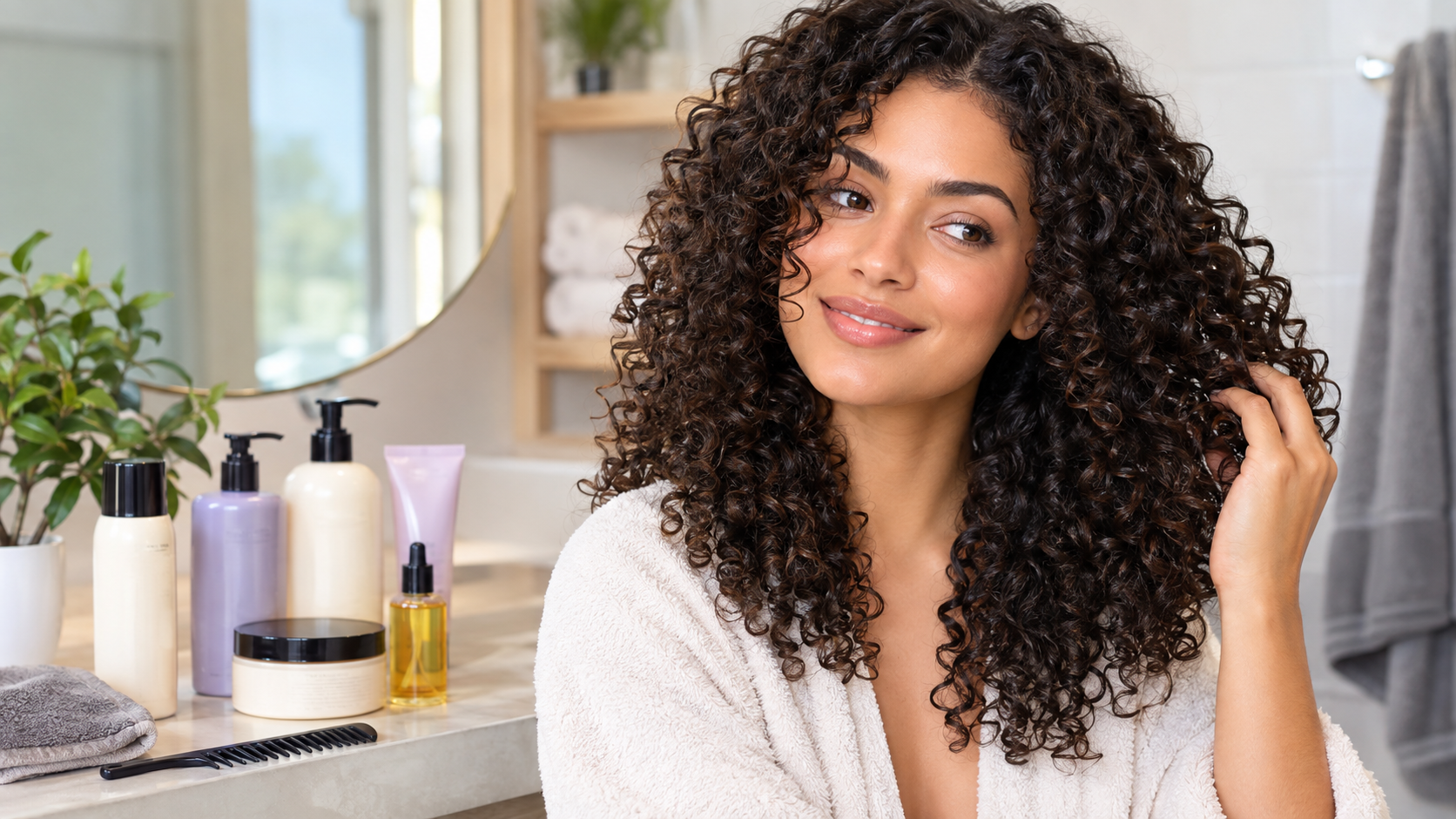
Curly hair products can make a major difference in how curls look, feel, and behave. The right combination can help define curls, reduce frizz, improve moisture, and make styling easier. However, there is no single product that works perfectly for every curly-haired person.
Curly hair varies in texture, density, porosity, curl pattern, and moisture needs. A lightweight leave-in conditioner may work beautifully for fine curls but feel insufficient for thick, dry hair. Similarly, a rich curl cream may help coarse curls while weighing down loose waves.
The best approach is to understand what your hair actually needs and then build a simple routine around those needs. This guide explains the main types of curly hair products, how to choose them, how to use them, common mistakes to avoid, and how to create a practical curly hair routine.
What Are Curly Hair Products?
Curly hair products are shampoos, conditioners, treatments, and styling products designed to support the needs of wavy, curly, and coily hair.
Common categories include:
- Curl-friendly shampoos
- Moisturizing conditioners
- Deep conditioners and hair masks
- Leave-in conditioners
- Curl creams
- Curl gels
- Mousses and foams
- Hair oils and serums
- Detangling products
- Heat protectants
- Scalp treatments
These products generally focus on moisture, curl definition, frizz management, detangling, softness, and hold.
The important point is that curly hair products are not interchangeable. A shampoo cleanses the scalp and hair, while a gel provides styling hold. A leave-in conditioner adds ongoing conditioning, whereas a clarifying shampoo is designed to remove buildup.
Why Does Curly Hair Need Special Care?
Curly hair often has a structure that makes it harder for natural scalp oils to travel along the length of the hair. The bends and curves in the hair can also make some types of curly hair more prone to dryness and tangling.
Frequent brushing, excessive heat, harsh cleansing, and aggressive towel drying can make frizz and breakage more noticeable.
A suitable curly hair routine therefore usually aims to balance three things:
- Cleansing – keeping the scalp and hair clean.
- Conditioning – maintaining softness and manageability.
- Styling – defining curls while controlling frizz and providing an appropriate level of hold.
The ideal balance depends on the individual person’s hair.
Best Types of Curly Hair Products
Understanding what each product does makes it much easier to build a routine.
1. Shampoo
Shampoo removes sweat, oil, dirt, styling residue, and product buildup from the scalp and hair.
For curly hair, the goal is effective cleansing without leaving the hair feeling unnecessarily dry or stripped.
Some people prefer gentle shampoos for regular washing and use a clarifying shampoo occasionally when buildup becomes a problem.
2. Conditioner
Conditioner helps improve softness, slip, and manageability after cleansing.
A good conditioner can make detangling easier and help reduce the friction associated with handling wet curls.
Look for a conditioner appropriate for your hair’s texture and moisture requirements rather than simply choosing the product marketed as “best for curls.”
3. Deep Conditioner and Hair Masks
Deep conditioning treatments are more intensive conditioning products that can be useful when hair feels particularly dry, rough, or difficult to manage.
They can be especially useful after:
- Frequent heat styling
- Chemical treatments
- Long periods without conditioning
- Exposure to dry environmental conditions
However, more conditioning is not automatically better. If hair begins feeling limp or coated, the routine may be too heavy.
4. Leave-In Conditioner
Leave-in conditioner is applied after washing and is not rinsed out.
It can provide additional conditioning and make curls easier to style. It is particularly useful for hair that becomes dry or tangled between washes.
For fine or low-density curls, a lightweight formula may be preferable. Thicker hair may tolerate richer formulas.
5. Curl Cream
Curl cream is primarily a styling product that can provide moisture, softness, and some curl definition.
It is often useful for people who want curls that feel touchable and flexible rather than heavily fixed.
A curl cream can also be combined with another styling product when additional hold is required.
6. Curl Gel
Gel provides stronger styling hold than many curl creams.
It can help curls maintain their shape and may be particularly useful for reducing frizz caused by humidity and movement.
Some gels create a temporary firm or crunchy feeling after drying. This is commonly called a cast. Depending on the formula, the cast can often be gently softened once the hair is completely dry.
7. Mousse and Foam
Mousse and foam are generally lighter styling options.
They can work well for:
- Fine curls
- Loose waves
- Adding volume
- Lightweight definition
- Reducing the heavy feeling that some creams create
The best choice depends on whether your priority is moisture, volume, hold, or a combination.
8. Hair Oils and Serums
Oils and serums can help with shine, smoothness, and finishing a hairstyle.
They should generally be used thoughtfully because applying too much can make curls look greasy or weighed down.
A few drops may be enough, particularly for fine hair.
Curly Hair Products by Hair Type
Instead of choosing products only according to curl pattern, consider your hair’s thickness, density, dryness, and styling goals.
| Hair characteristic | Products that may work well | What to watch for |
|---|---|---|
| Fine curls | Lightweight leave-in, mousse, light gel | Heavy creams and excessive oils |
| Thick curls | Rich conditioner, curl cream, gel | Insufficient moisture |
| Dry curls | Moisturizing conditioner, leave-in, cream | Overloading hair with products |
| Loose waves | Lightweight mousse, foam, light gel | Products that reduce volume |
| Tight curls/coils | Rich conditioner, leave-in, cream, gel | Tangling and dryness |
| Oily scalp | Appropriate cleansing shampoo, lightweight conditioner | Heavy products near the scalp |
| High-density hair | Sectioning products during styling | Uneven application |
These are starting points rather than strict rules. Two people with the same curl pattern can have completely different product requirements.
How to Choose Curly Hair Products
The simplest way to choose products is to identify your biggest hair problem first.
If Your Hair Is Dry
Prioritize conditioning products such as:
- Moisturizing conditioner
- Leave-in conditioner
- Curl cream
- Occasional deep-conditioning treatment
Avoid automatically layering several heavy products. Start with a small amount and increase only when necessary.
If Your Hair Is Frizzy
Frizz can have many causes, including humidity, dryness, friction, damage, and inconsistent styling.
A routine may include:
- Conditioner
- Leave-in conditioner
- Curl cream
- Gel for stronger hold
- Gentle drying techniques
A styling product cannot completely eliminate every type of frizz, but it can improve definition and help curls stay grouped together.
If Your Curls Lack Definition
Try improving the styling process before buying more products.
Apply styling products to sufficiently wet hair, distribute them evenly, and use a curl-forming technique that works with your texture.
A gel or mousse can provide additional hold after a leave-in or curl cream.
If Your Hair Gets Weighed Down
Reduce the amount of product before replacing everything.
You may need:
- Less curl cream
- A lighter leave-in
- Less oil
- A lightweight mousse or foam
- More thorough cleansing when buildup occurs
Fine hair often benefits from a simpler routine.
Curly Hair Product Routine: Step by Step
A consistent routine does not need to contain ten different products.
Step 1: Cleanse
Wash your scalp with an appropriate shampoo.
Focus shampoo primarily on the scalp rather than aggressively scrubbing the lengths.
Step 2: Condition
Apply conditioner through the lengths and ends.
Use your fingers or a suitable detangling method to work through knots gently.
Step 3: Detangle Carefully
Curly hair is often easier to detangle when wet and conditioned.
Work from the ends toward the roots rather than pulling forcefully from the top.
Step 4: Apply Leave-In Conditioner
If your hair needs additional moisture, apply a small amount of leave-in conditioner.
Distribute it evenly rather than concentrating a large amount in one area.
Step 5: Add a Styling Product
Choose based on your desired result.
For example:
- Cream: softness and flexible definition
- Mousse: volume and lightweight styling
- Gel: stronger hold and definition
- Foam: lightweight styling and volume
You do not necessarily need all of them.
Step 6: Shape the Curls
Use your preferred curl-forming technique, such as scrunching or another gentle styling method.
Avoid repeatedly disturbing curls while they are drying.
Step 7: Dry Gently
Allow hair to air dry or use a diffuser when appropriate.
Avoid aggressive rubbing with a conventional towel because friction can contribute to frizz and tangling.
Step 8: Finish
Once completely dry, assess the result.
If needed, use a very small amount of finishing product to smooth or add shine.
Product Layering: What Goes First?
The order of application can affect how curly hair products perform.
| Step | Product type | Main purpose |
|---|---|---|
| 1 | Shampoo | Cleansing |
| 2 | Conditioner | Conditioning and detangling |
| 3 | Leave-in | Additional moisture |
| 4 | Curl cream | Definition and softness |
| 5 | Mousse/foam | Lightweight styling and volume |
| 6 | Gel | Hold and definition |
| 7 | Oil/serum | Finishing and shine |
You do not need to use every step.
For many people, a simple routine such as conditioner → leave-in → gel can be enough.
Ingredients to Consider in Curly Hair Products
Reading ingredient lists can be more useful than relying on marketing labels.
Depending on your needs, you may encounter ingredients such as:
- Humectants, which can help attract and retain moisture
- Emollients, which help improve softness and smoothness
- Conditioning agents, which improve manageability
- Film-forming ingredients, which can help create hold and reduce frizz
- Cleansing agents, which remove oils and buildup
There is no universal ingredient list that every curly-haired person must avoid.
For example, an ingredient that works well for one person’s hair may not produce the same result for someone else.
Do Curly Hair Products Make Hair Grow Faster?
No. Styling products do not automatically make hair grow faster. Hair growth is primarily related to biological factors, including genetics and the health of the scalp and hair follicles.
Curly hair products can support healthier-looking, more manageable hair by improving conditioning, reducing friction, and helping prevent unnecessary breakage. That can make it easier to retain length, but it is different from directly increasing the rate at which hair grows.
If you experience sudden or significant hair loss, persistent scalp problems, or other concerning changes, consider speaking with a qualified healthcare professional.
Common Mistakes When Using Curly Hair Products
Using Too Much Product
More product does not necessarily mean better curls.
Excessive layering can create:
- Heavy curls
- Greasy-looking hair
- Reduced volume
- Product buildup
Start with a small amount and add more only if needed.
Choosing Products Only by Curl Pattern
Curl pattern is useful, but it is not the whole story.
Hair thickness, density, porosity, dryness, scalp condition, and climate can all affect product performance.
Applying Products Unevenly
If styling products are concentrated in only a few sections, the final result may look inconsistent.
Divide thicker hair into sections when necessary.
Brushing Dry Curls Aggressively
Dry brushing can disrupt curl formation and increase visible frizz for many curl types.
If you need to detangle, use a method appropriate for your hair and work gently.
Changing Your Entire Routine at Once
If you introduce five new products simultaneously, it becomes difficult to identify which product is helping or causing problems.
Change one major variable at a time when possible.
Ignoring Buildup
Even good curly hair products can become problematic when too much residue accumulates.
If your hair suddenly feels coated, dull, heavy, or unusually difficult to style, reassess your cleansing and styling routine.
Curly Hair Products vs. DIY Hair Treatments
DIY treatments are popular online, but “natural” does not automatically mean safer or more effective.
Commercial curly hair products are formulated for specific cosmetic purposes and generally provide more predictable application and performance.
Homemade treatments can also vary considerably in consistency and concentration.
If you experiment with DIY ingredients, avoid treating internet claims as medical advice and be cautious with anything that could irritate the scalp or damage hair.
How to Build a Simple Curly Hair Routine
A beginner does not need a bathroom full of products.
Start with these basics:
- Shampoo appropriate for your scalp.
- Conditioner suited to your hair’s moisture needs.
- Leave-in conditioner if additional conditioning is useful.
- One styling product, such as gel, mousse, or curl cream.
- Optional finishing product such as a light serum or oil.
Use the smallest effective amount.
After several washes, evaluate the results. If your hair is dry, adjust conditioning. If it is flat or heavy, reduce product weight. If curls lose their shape quickly, consider a styling product with more hold.
Frequently Asked Questions About Curly Hair Products
What are the best curly hair products?
The best curly hair products depend on your hair’s texture, density, dryness, scalp condition, and styling goals. A useful starting routine includes shampoo, conditioner, and one suitable styling product.
How often should I use curly hair products?
It depends on the product. Shampoo and conditioner are generally used as part of your washing routine, while styling products can be used whenever you style your hair. Follow the product’s directions and adjust based on how your hair responds.
Are expensive curly hair products better?
Not necessarily. Price alone does not determine whether a product will work for your hair. Formula, application, hair characteristics, and personal preference are often more important.
Can curly hair products reduce frizz?
Yes, appropriate conditioning and styling products can help improve the appearance of frizz and keep curls more defined. Results vary depending on the hair and environmental conditions.
Should I use curl cream or gel?
Choose curl cream when you mainly want softness, moisture, and flexible definition. Choose gel when you need stronger hold and longer-lasting curl definition. Some people use both.
Are oils good for curly hair?
Oils can provide shine and a smoother finish, but the ideal amount varies. Fine hair may become weighed down easily, while thicker or drier hair may tolerate richer finishing products.
Why do my curls look greasy after using products?
Greasy-looking curls can result from using too much product, choosing a formula that is too heavy, applying product close to an oily scalp, or experiencing buildup. Try reducing the quantity or switching to a lighter formula.
How many curly hair products do I really need?
You can create an effective routine with only a few products. A cleanser, conditioner, and one styling product may be enough for many people. Add products only when they solve a specific problem.
Final Thoughts on Curly Hair Products
Finding the right curly hair products is less about following a universal product list and more about understanding your own hair. Texture, density, moisture needs, scalp condition, climate, and styling preferences all influence what works best.
Start with a simple routine, introduce products gradually, and pay attention to how your curls respond. A lightweight routine may be ideal for fine curls, while thicker or drier hair may benefit from richer conditioning and stronger styling products.
Most importantly, focus on consistent care rather than chasing every new product trend. The right combination of cleansing, conditioning, gentle handling, and appropriate styling can help your natural curls look healthier, more defined, and easier to manage.