

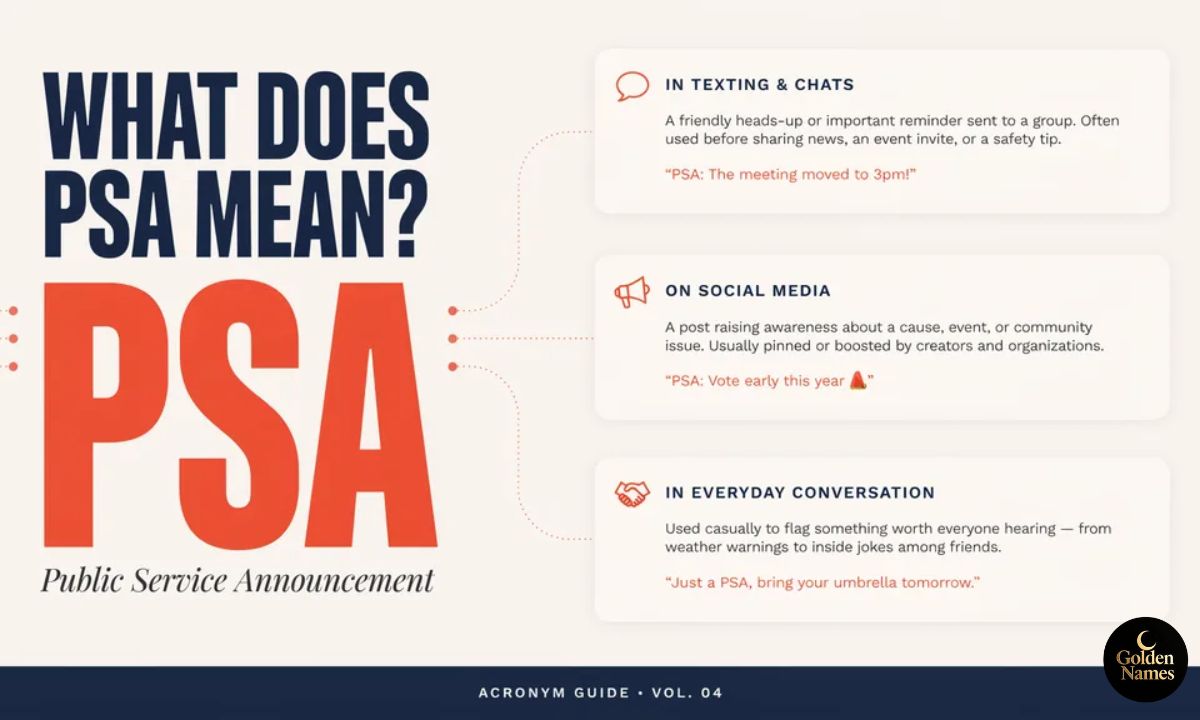
If you spend time on social media, group chats, online forums, or texting apps, you’ve probably seen someone start a message with PSA and wondered what it means.
The acronym appears everywhere. People use it on TikTok captions, Instagram stories, Reddit discussions, Facebook posts, WhatsApp groups, and even workplace chats. Sometimes it introduces useful information. Other times it is used humorously or sarcastically.
Understanding PSA meaning helps you interpret conversations correctly and avoid confusion. While the term originally came from official public announcements, it has evolved into a popular internet expression used to grab attention and highlight important information.
This guide explains exactly what PSA means, where it came from, how people use it online, common examples, alternative meanings, mistakes people make, and how you can use it naturally in your own conversations.
What Does PSA Mean
PSA stands for:
Public Service Announcement
In modern texting and internet slang, PSA is commonly used before sharing information that the sender believes is important, useful, interesting, or worth everyone’s attention.
Think of it as saying:
- Listen up
- Quick reminder
- Important information
- Helpful tip
- Friendly warning
- Heads up
Simple Definition
PSA means you’re about to share something people should know.
For example:
- PSA: The store closes early today.
- PSA: Remember to save your work before updating your computer.
- PSA: The parking lot is full after 6 PM.
The phrase helps grab attention without sounding aggressive or demanding.
What Is the Full Form of PSA
| Acronym | Full Form |
| PSA | Public Service Announcement |
Originally, public service announcements were messages broadcast on television, radio, and other media to inform the public about important issues.
Examples included:
- Health awareness campaigns
- Road safety reminders
- Emergency alerts
- Community notices
- Public education programs
Over time, internet users adopted the term and gave it a more casual meaning.
Today, PSA is commonly used in everyday conversations rather than official broadcasts.
The Origin of PSA
The phrase Public Service Announcement dates back to the mid-20th century.
Governments, nonprofit organizations, and public institutions used PSAs to communicate important information to large audiences. These announcements focused on topics such as:
- Public safety
- Health education
- Emergency preparedness
- Environmental awareness
- Community welfare
As online communication became more common, internet users borrowed the term and began using it before sharing advice, warnings, or observations.
Eventually, PSA became part of digital culture and internet slang. Today, millions of people use it daily across social media platforms.
PSA Meaning in Text Messages
In texting, PSA usually introduces information the sender wants everyone to notice.
Examples
- PSA: The meeting starts at 9 AM tomorrow.
- PSA: Bring an umbrella today.
- PSA: The restaurant requires reservations now.
- PSA: Don’t forget to submit your assignment.
The message may be serious, helpful, funny, or completely random.
The main goal is to make readers pay attention.
PSA Meaning on Social Media
Social media users often place PSA at the beginning of posts to highlight a statement.
People use PSA in captions and stories.
Examples:
- PSA: Drink more water today.
- PSA: This coffee shop is worth visiting.
- PSA: Sunscreen matters even on cloudy days.
TikTok
Creators often use PSA before sharing:
- Life hacks
- Warnings
- Product recommendations
- Educational content
- Personal experiences
Example:
“PSA: Check your subscription settings before free trials renew.”
Facebook users frequently post PSAs in community groups.
Examples include:
- Local traffic updates
- Event reminders
- Weather alerts
- Neighborhood announcements
X and Threads
Short-form platforms are ideal for PSA-style posts because the format quickly captures attention.
PSA Meaning on Reddit
Reddit communities regularly use PSA in discussion threads.
A Reddit user might write:
- PSA: This software update causes login issues.
- PSA: You can save money by buying tickets early.
- PSA: The event location has changed.
Sometimes the term is used seriously.
Sometimes it is used sarcastically for comedic effect.
Example:
“PSA: Staying up until 3 AM still makes you tired.”
How PSA Is Used in Everyday Conversations
People use PSA for many different purposes.
Sharing Helpful Advice
Example:
PSA: Back up your phone before installing updates.
Giving Warnings
Example:
PSA: Watch out for phishing emails this week.
Making Announcements
Example:
PSA: Dinner is ready.
Sharing Recommendations
Example:
PSA: This movie is worth watching.
Adding Humor
Example:
PSA: Ice cream disappears quickly when you leave it in the sun.
Common PSA Examples
Here are examples you might encounter online.
Serious PSA Examples
- PSA: Wear your seatbelt every time you drive.
- PSA: Check weather warnings before traveling.
- PSA: Update your passwords regularly.
Helpful PSA Examples
- PSA: Grocery stores are less crowded early in the morning.
- PSA: Save important files to cloud storage.
- PSA: Compare prices before making major purchases.
Funny PSA Examples
- PSA: One episode often becomes five episodes.
- PSA: Snacks disappear faster during movie night.
- PSA: Monday arrives every week whether you’re ready or not.
Relationship PSA Examples
- PSA: Communication solves most misunderstandings.
- PSA: Respect personal boundaries.
- PSA: Small acts of kindness matter.
Why Do People Use PSA
There are several reasons why PSA remains popular.
It Gets Attention
People immediately recognize PSA as a signal that something important follows.
It Saves Time
A short acronym conveys a clear purpose quickly.
It Sounds Friendly
PSA often feels less demanding than giving direct instructions.
It Works Across Platforms
The term is widely understood on social media, messaging apps, forums, and workplace communication tools.
Different Tones of PSA
One interesting thing about PSA is that its tone changes depending on context.
Informative Tone
PSA: The office closes early today.
Educational Tone
PSA: Drinking enough water supports overall health.
Warning Tone
PSA: Double-check links before entering passwords.
Humorous Tone
PSA: Buying one snack often leads to buying five more.
Sarcastic Tone
PSA: Being late usually makes you late.
Understanding tone helps you interpret the message correctly.
Alternative Meanings of PSA
Although Public Service Announcement is the most common meaning online, PSA can have other definitions depending on the context.
| Field | Meaning |
| Internet Slang | Public Service Announcement |
| Medicine | Prostate-Specific Antigen |
| Business | Professional Sports Authenticator |
| Technology | Various technical abbreviations |
| Science | Field-specific terminology |
Context usually makes the intended meaning obvious.
For example:
A doctor discussing PSA is likely referring to Prostate-Specific Antigen.
A TikTok creator using PSA is almost certainly referring to Public Service Announcement.
How to Respond to a PSA
There is no special rule for replying.
You can respond naturally based on the message.
Examples:
When It Is Helpful
Thanks for the reminder.
Good to know.
I didn’t realize that.
When It Is Funny
That’s actually true.
This made me laugh.
Very accurate.
When It Is Important
Thanks for sharing.
I’ll keep that in mind.
Appreciate the heads up.
Common Mistakes People Make About PSA
Assuming It Is Always Serious
Many PSAs are humorous or sarcastic.
Thinking It Is New Slang
The phrase has existed for decades and simply evolved into internet culture.
Confusing It With Other Acronyms
PSA can mean different things in medical, scientific, and business settings.
Ignoring Context
Context is essential when determining the intended meaning.
Pros and Cons of Using PSA
Pros
- Easy to understand
- Grabs attention quickly
- Works across platforms
- Useful for sharing information
- Can be serious or humorous
Cons
- Some readers may not know the acronym
- Can seem overdramatic if overused
- Different industries use different meanings
- Tone can sometimes be misunderstood
PSA vs Reminder
Many people wonder whether PSA and reminder mean the same thing.
Not exactly.
| PSA | Reminder |
| Shares important information | Reminds people of something known |
| Can be educational | Usually references an existing task |
| Often public | Can be personal |
| May include warnings | Usually focuses on remembering something |
Example:
Reminder: Submit your report today.
PSA: Reports submitted after 5 PM will not be accepted.
PSA vs FYI
PSA and FYI are sometimes confused.
PSA
Signals information that deserves attention.
Example:
PSA: The website is temporarily offline.
FYI
Simply provides information.
Example:
FYI: I already emailed the document.
A PSA usually feels more urgent or important than FYI.
When Should You Use PSA
Use PSA when:
- Sharing useful information
- Giving friendly warnings
- Posting helpful advice
- Making community announcements
- Highlighting something important
Avoid using PSA when the information is highly personal or irrelevant to others.
Frequently Asked Questions
What does PSA mean in slang
In slang, PSA stands for Public Service Announcement. It is used to share information, advice, reminders, warnings, or observations with a wider audience.
What does PSA mean in texting
In texting, PSA usually means someone is about to share something they consider important or useful.
What does PSA mean on TikTok
On TikTok, PSA is often used before educational tips, warnings, life hacks, opinions, or humorous observations.
Is PSA a formal term
Originally yes. Today it is used both formally and informally.
Can PSA be sarcastic
Yes. Many internet users use PSA sarcastically for comedic effect.
What does PSA mean on Instagram
On Instagram, PSA usually introduces advice, reminders, opinions, recommendations, or announcements.
What does PSA mean in a relationship
In relationship discussions, PSA typically means Public Service Announcement and is used to emphasize advice, boundaries, communication tips, or observations.
Is PSA still popular
Yes. PSA remains widely used across texting apps, social media platforms, online forums, and community discussions.
Conclusion
PSA stands for Public Service Announcement, but its modern meaning goes far beyond traditional broadcasts. In texting, social media, online communities, and everyday conversations, PSA has become a simple way to share information that people should notice.
Whether someone is giving advice, posting a warning, sharing a recommendation, or making a joke, PSA acts as a signal that says, Pay attention to this.
Understanding PSA meaning makes it easier to follow online conversations, interpret social media posts correctly, and communicate more effectively yourself. Once you recognize how people use it, you’ll start spotting PSAs almost everywhere on the internet.