

If you've been texting lately, you've probably seen "MB" pop up in a message and wondered what it actually means. It's one of those two-letter abbreviations that can seem confusing at first, but once you know it, you'll notice it everywhere. The truth is, MB is super common in today's digital conversations, and understanding it makes texting way easier.
The good news? MB isn't complicated at all. Whether you're chatting with friends, scrolling through social media, or gaming online, you'll encounter this abbreviation regularly. This guide breaks down everything you need to know about MB, including what it means, where people use it, and why it's become such a staple in internet culture.
Quick Answer
MB stands for My Bad. It's a casual, informal way to apologize for a small mistake or acknowledge that you made an error. People use it to take responsibility without sounding too serious or formal. Think of it as the digital version of saying "Oops, my mistake!" in a friendly, laid-back way.
What Does MB Mean in Text?
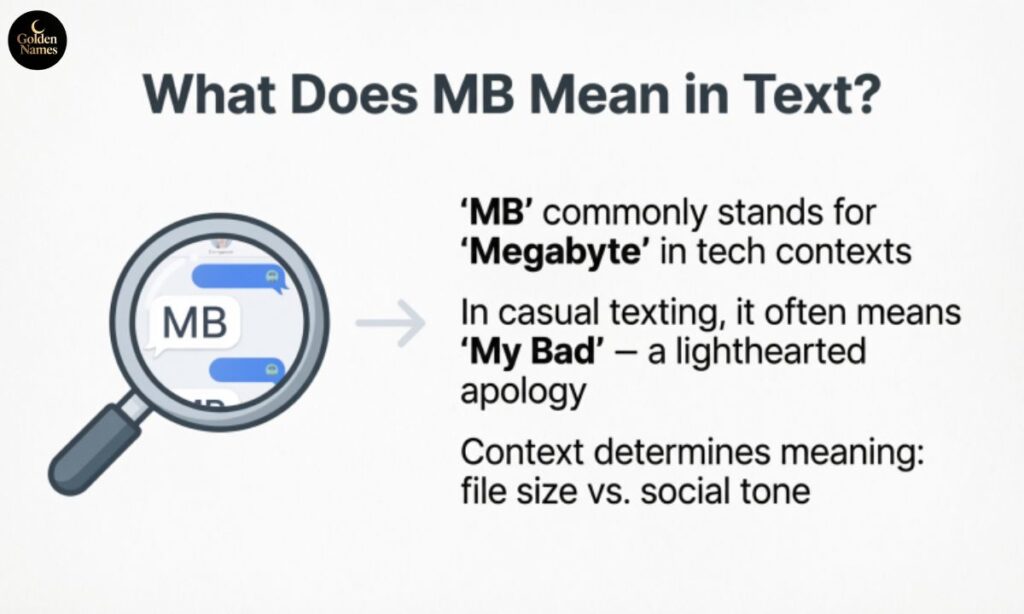
MB is an internet slang abbreviation that primarily means My Bad. It's used when someone realizes they've made a small mistake and wants to acknowledge it quickly. The phrase my bad itself isn't new, it's been part of casual speech for decades, but abbreviating it to MB took off with texting and online chat culture.
When someone sends you MB," they're essentially saying:
- I made a mistake
- That was my fault
- Sorry about that
- My apologies
The beautiful thing about MB is that it keeps things light and informal. It's not a serious, formal apology. Instead, it's what you'd say to a friend when you accidentally forgot their birthday or sent a text to the wrong person. It's casual, quick, and gets the point across without making a big deal out of the error.
Example in context: You tell your friend you'll meet them at 7 PM. At 7:15 PM, you realize you were at the wrong coffee shop. You text: MB Wrong location. Be there in 10.
Your friend immediately understands you made a mistake and are taking responsibility for it. No lengthy explanation needed.
Main Meaning Table
| Abbreviation | Meaning | Context | Tone |
| MB | My Bad | General texting, casual chat | Friendly, light |
| MB | Maybe | Expressing uncertainty | Neutral, informal |
| MB | Message Back | Requesting a reply | Direct, casual |
| MB | Megabyte | Technical/data discussions | Professional |
| MB | Motherboard | Gaming or tech talk | Technical |
| MB | Mind Blown | Social media reactions | Excited, amazed |
Where Is MB Used?
Social Media Platforms
Instagram and TikTok: You'll see MB in comments and DMs constantly. Someone might comment MB, didn't see your post earlier" or use it in a caption. It's become part of the visual language of these platforms.
Twitter/X: Twitter users frequently drop "MB" in replies when they realize they've made a mistake in a previous tweet or misunderstood something.
Snapchat: MB appears in quick snap messages, where speed and brevity are valued. A friend might send you a snap saying MB for not responding sooner.
Facebook: While Facebook tends to be slightly more formal, MB still shows up in messenger conversations and casual comments.
Reddit: In Reddit communities, MB is common in comment threads when someone corrects themselves or admits they were wrong.
Text Messaging and Chat Apps
SMS and iMessage: This is where MB originated and where it's most common. Quick text corrections and casual apologies use MB frequently.
WhatsApp and Messenger: Group chats are full of MB when people realize they've made mistakes or sent messages to the wrong group.
Discord: Gaming communities on Discord use MB constantly. You might see "MB, I didn't see that message or MB, lag got me.
Slack: Even in workplace chats, people use MB casually when acknowledging small mistakes: MB, sent that to the wrong channel.
Gaming and Online Communities
In gaming, MB serves multiple purposes. A player might say "MB team, I got caught out there after making a bad play. In competitive gaming, acknowledging mistakes quickly helps teams move on to the next round. Gaming chats are fast-paced, so MB saves typing time while still communicating responsibility.
School and Work (Informal Settings)
In educational settings, students use MB when messaging classmates. A college student might text a study group MB, wasn't paying attention to that part. In casual workplace messaging, colleagues use it too: MB, I forgot to attach that file. Here it is now.
Different Meanings of MB
While "My Bad" is the most common meaning, context changes everything. Understanding which MB you're dealing with prevents confusion.
1. My Bad (Apology)
Meaning: Taking responsibility for a mistake Context: Casual texting, friendly conversations Example: I told you 8 PM but meant 9. MB!" Tone: Light, non-serious, friendly
This is the primary meaning and the one you'll encounter most often. It's appropriate with friends, family, and casual acquaintances. It's not suitable for serious apologies or professional settings where mistakes have real consequences.
2. Maybe (Uncertainty)
Meaning: Expressing uncertainty or doubt Context: When someone isn't sure about plans or decisions Example: You coming to the party?" "MB, depends on work. Tone: Casual, non-committal
This usage is less common but definitely exists. It's a more casual version of maybe and conveys indecision. People often pair it with other signals like "I'll let you know or not sure yet.
3. Message Back (Request)
Meaning: Please respond to my message Context: When you want someone to reply Example: Got the details? MB when you can. Tone: Polite, casual request
This is relatively uncommon but appears in messaging apps where quick responses matter. It's a shorthand way to ask for a reply without sounding demanding.
4. Megabyte (Technical)
Meaning: A unit of digital storage (1,024 kilobytes) Context: Technical discussions, file transfers, specifications Example: This photo is 3 MB. Should upload fine." Tone: Professional, technical
In technical contexts, MB is completely different from the slang meaning. It's a standard abbreviation for megabyte, used when discussing file sizes, data transfer, or device specifications. Readers can usually tell the difference based on context, if someone's talking about digital files or data, MB means megabyte.
5. Mind Blown (Reaction)
Meaning: That's amazing or shocking Context: Social media reactions, surprising news Example: You got the promotion? MB that's incredible!" Tone: Excited, amazed
This is more slang and less common than "my bad," but it appears in reactions to surprising or impressive news. You might see it in comments or quick text reactions.
6. Motherboard (Gaming/Tech)
Meaning: The main circuit board in a computer Context: Gaming setups, tech discussions, computer building Example: I need a new MB for my gaming PC. Tone: Technical, hardware-focused
Gamers and tech enthusiasts use this abbreviation when discussing computer components. It's clear from the context that they're talking about hardware rather than apologies.
Real Chat Examples
Example 1: The Forgotten Appointment
Sarah: Did you pick up my dry cleaning? Mike: Oh no. MB! I completely forgot. Going now. Sarah: It's okay. Thanks for the heads up.
Here, Mike uses MB to acknowledge his mistake immediately. It's light and friendly, he's taking responsibility but not making it overly serious.
Example 2: Texting the Wrong Person
You: Hey, are we still on for tonight? Random Number: I think you have the wrong number You: MB! Wrong contact. Sorry about that!
This is a common scenario where MB saves the day. It quickly clarifies that you made an honest mistake without needing a lengthy explanation.
Example 3: Gaming Mishap
Player 1: Why'd you rush in alone? Player 2: MB team, didn't see them coming. My bad. Player 1: All good, we got the next one.
In competitive games, players use MB to take responsibility for bad plays. It helps the team move forward without dwelling on the mistake.
Example 4: Uncertainty About Plans
Friend 1: Want to grab lunch at noon? Friend 2: MB, not sure if I can make it. Got stuck at work yesterday. Friend 1: No worries, let me know when you know more.
Here MB means "maybe" because Friend 2 is expressing uncertainty about their availability.
Example 5: Group Chat Situation
Group Chat Member: That was such a stupid thing to say in the meeting. Group Chat Member 2: MB, that wasn't cool. We were just trying to help.
This shows how MB can appear when someone realizes they've said something wrong in a group conversation and wants to correct course.
Example 6: Social Media Comment
Original Post: Just landed my dream job! Comment: MB, thought you were still looking. That's amazing!
Here the commenter realizes they had outdated information and uses MB to acknowledge the mistake before congratulating the person.
Why Do People Use MB?
Understanding why MB became so popular helps you see how the internet language evolves.
Speed and Efficiency
Text messaging started with limited characters. Early phones charged by the message, and typing was slow. Using MB instead of "my bad" saved precious characters and time. This habit stuck around even though modern phones and unlimited messaging removed these limitations. People still value speed in digital communication.
Casual Tone
MB keeps things light and friendly. A full apology like I'm terribly sorry for my mistake feels too formal for casual texting. MB hits the perfect middle ground, it acknowledges the error without sounding stiff or overly apologetic. It's the texting equivalent of a shoulder shrug with a smile.
Low-Stakes Mistakes
MB works perfectly for minor mistakes that don't need serious apologies. Forgetting to respond quickly, sending a text to the wrong person, or misremembering a time—these are the situations MB handles well. For serious mistakes, a real apology is more appropriate.
Internet Culture and Trend
Gen Z grew up with texting and internet slang. Abbreviations are part of their native digital language. Using MB signals that you're part of modern internet culture. It's become normalized to the point where people use it automatically without thinking about it.
Emotional Distance
There's something about typing "MB" instead of saying a full apology out loud that creates a comfortable distance. It lets you acknowledge a mistake without the awkwardness of a face-to-face apology. This works especially well with casual friends who understand your humor and tone.
Community Belonging
Using recognized internet slang like MB signals that you understand the culture of texting and online spaces. It's a small way of showing you're in the loop and know how to communicate in digital spaces.
Is MB Still Popular in 2026?
Absolutely. MB remains one of the most common internet slang abbreviations in 2026, showing no signs of disappearing. Here's why it's staying power is strong:
Still widely used across platforms: From TikTok to Twitter to Discord, MB appears constantly in digital conversations. New users learn it quickly because it's everywhere.
Cross-generational acceptance: While it started with younger generations, MB has become accepted across age groups. Even older people who text frequently understand and use it.
Efficient communication: Unlike some trendy slang that fades away, MB solves a practical problem—it's a quick way to apologize or express uncertainty. Practical language tends to stick around.
Evolution continues: As the internet evolves, so does slang. MB hasn't been replaced by newer abbreviations because it serves its purpose effectively. Newer terms like "TLDR" or "GOAT" address different communication needs.
Accessibility: MB is short, easy to spell, and easy to understand. Compared to more complex internet slang, MB is accessible to anyone texting online, making it more likely to remain popular.
Platform consistency: People use MB on every major social media and messaging platform. This consistency across platforms reinforces its popularity.
The only change in 2026 is that MB feels even more normal and standard. New people joining online communities learn it naturally, the same way previous generations learned email etiquette.
Pros and Cons
Pros of Using MB
- Quick and efficient: Saves time in fast-paced conversations
- Casual and friendly: Sets a relaxed tone without sounding rude
- Universally understood: Most people online recognize what it means
- Appropriate for minor mistakes: Perfect for low-stakes situations
- Helps relationships: Acknowledging mistakes keeps friendships smooth
- Prevents overthinking: No need to craft a lengthy apology for small errors
- Works across platforms: Recognized on every major social media site
- Natural and conversational: Doesn't feel forced or formal
Cons of Using MB
- Too casual for serious situations: Not appropriate for major mistakes or apologies
- Can seem dismissive: In some contexts, it might minimize the seriousness of an error
- Potential for misunderstanding: Different meanings depending on context
- Not professional enough: Avoid in formal workplace communication or official correspondence
- May seem passive-aggressive: Tone through text is hard to convey; MB could be interpreted negatively
- Loses effectiveness with overuse: Using it for everything eventually makes apologies meaningless
- Cultural barriers: People unfamiliar with internet slang might not understand it
- No emotional depth: Can't replace genuine, heartfelt apologies for serious matters
Comparison Table
| Platform | Most Common Meaning | Typical Tone | Frequency |
| Text Messages | My Bad | Casual, friendly | Very High |
| Instagram DMs | My Bad | Playful, casual | Very High |
| TikTok Comments | My Bad | Light, quick | High |
| Discord | My Bad | Informal, quick | Very High |
| Snapchat | My Bad | Fast, brief | Very High |
| Twitter/X | My Bad | Casual, reactive | High |
| My Bad | Conversational | Medium-High | |
| Slack (Work) | My Bad | Casual-professional | Medium |
| My Bad | Mixed tone | Medium | |
| Gaming Chat | My Bad | Quick, team-focused | Very High |
| Professional Email | Rarely Used | N/A | Very Low |
| Formal Settings | Not Used | N/A | Almost Never |
Common Mistakes People Make
Mistake 1: Using MB for Serious Apologies
Wrong: Using MB when you've genuinely hurt someone or made a significant mistake. Right: Save MB for minor things. For serious situations, write a real apology that shows you understand the impact of your actions. Example: If you missed an important event, "MB" isn't enough. A proper apology explains what happened and shows you care.
Mistake 2: Confusing MB Meanings
Wrong: Assuming MB always means My Bad without considering context. Right: Pay attention to what's being discussed. In a tech conversation about file sizes, MB means megabyte. In a casual chat, it usually means my bad. Example: When someone says "Download this, it's only 15 MB, they're talking about data size, not apologizing.
Mistake 3: Overusing MB in Professional Contexts
Wrong: Treating your workplace Slack like you text your best friend. Right: Save MB for informal workplace chats with people you know well. For official communication, use proper language. Example: In an email to your boss, write My apologies instead of MB.
Mistake 4: Using MB Sarcastically Without Clear Context
Wrong: Sending MB sarcastically when you're actually not sorry, causing real confusion. Right: Be careful with sarcasm in text. Make sure the other person knows you're joking, or it comes across as rude. Example: If someone genuinely expected an apology, sarcastic "MB" will damage the relationship.
Mistake 5: Not Reading the Room
Wrong: Using casual MB when someone is actually upset about something. Right: Match your tone to the situation. If someone is genuinely hurt, a proper apology is needed, not just MB. Example: Someone is upset you forgot their birthday. "MB" alone will seem dismissive.
Mistake 6: Assuming Everyone Knows What MB Means
Wrong: Using MB with people who aren't familiar with internet slang (older relatives, international contacts, formal contexts). Right: If uncertain, spell it out the first time: MB (my bad), I forgot to call you yesterday. Example: Your grandmother might have no idea what you mean by just MB.
Mistake 7: Using MB Without Taking Real Responsibility
Wrong: Throwing out MB to brush off accountability without actually fixing the problem. Right: Back up MB with action. If you're consistently late, MB" isn't enough, you need to actually show up on time. Example: Don't just say "MB, I keep forgetting. Either put in the effort to remember or explain why you can't.
Frequently Asked Questions
What does MB mean in texting
MB most commonly means My Bad, which is a casual way to apologize for a small mistake or acknowledge an error. It's friendly and informal, often used between friends and online. For example, if you forget to respond to a message, you might say MB, just saw this to show you made a mistake and are acknowledging it quickly. The beauty of MB is that it keeps things light without sounding overly formal or serious.
Is MB informal or can it be professional
MB is definitely informal and casual. It's best suited for texting with friends, family, and casual acquaintances. In professional settings like emails to your boss or official correspondence, avoid using MB. Instead, use proper language like My apologies or I apologize. However, in informal workplace chats (like Slack with coworkers you know well), MB is acceptable. The key is reading the situation and matching your tone to the context.
What are alternative meanings of MB besides My Bad
Beyond My Bad, MB can mean Maybe (expressing uncertainty), Message Back (requesting a reply), Megabyte (a data measurement), Motherboard (computer hardware), or Mind Blown (amazement). The meaning depends entirely on context. In a tech conversation about file sizes, MB means megabyte. In casual texting, it usually means My Bad or Maybe. Looking at the surrounding conversation helps you figure out which meaning applies.
Can I use MB in formal communication like emails or job applications
No, avoid MB in formal communication. Job applications, emails to authority figures, formal letters, and official documentation should use proper language and complete words. MB is reserved for casual digital communication with people you know. Using it in formal settings might make you seem unprofessional or like you don't take the situation seriously. When in doubt, spell everything out and avoid abbreviations in formal writing.
How do I know if someone’s using MB as an apology or something else
Look at the context of the conversation. If someone just made a mistake or realized they said something wrong, MB means My Bad. If they're expressing uncertainty about plans or decisions, it probably means Maybe. If they're discussing computer files or specifications, it means Megabyte. If it's a reaction to surprising news, it might mean Mind Blown. The surrounding text usually makes the meaning clear. When in doubt, ask for clarification, it's better than guessing wrong.
Should I teach my kids about MB or worry about them using it too much
MB is a normal part of modern communication, and knowing what it means helps your kids understand texting culture. Teaching them what it means is useful, so they can read messages correctly and understand their peers. However, like all slang, it should be used appropriately, for casual chats, not formal schoolwork or official communication. Help them understand when MB is appropriate (texting friends) and when it's not (emails to teachers). Balance is key.
Will MB become outdated soon or stay popular
MB shows strong staying power in 2026 and likely beyond. Unlike trendy slang that fades quickly, MB solves a practical problem, it's an efficient way to apologize casually in digital conversations. As long as people text and use social media, they'll need a quick way to acknowledge mistakes. MB has become ingrained in internet culture across all age groups and platforms. Don't expect it to disappear anytime soon. It's become as standard as "lol" or omg in digital communication.
Conclusion
MB is everywhere in modern texting and social media, and now you know exactly what it means and how to use it. Whether you're texting friends, commenting on TikTok, or chatting on Discord, MB is the casual, efficient way to acknowledge a small mistake or express uncertainty. The key is understanding the context and knowing when it's appropriate.
Remember, MB is informal and friendly. Use it for minor mistakes with people you know well, but save proper apologies for serious situations. Understanding when to use MB and when to spell things out shows you have good digital communication skills. So next time you see "MB" pop up in a message, you'll know exactly what it means and how to respond naturally and confidently in the fast-paced world of online communication.