

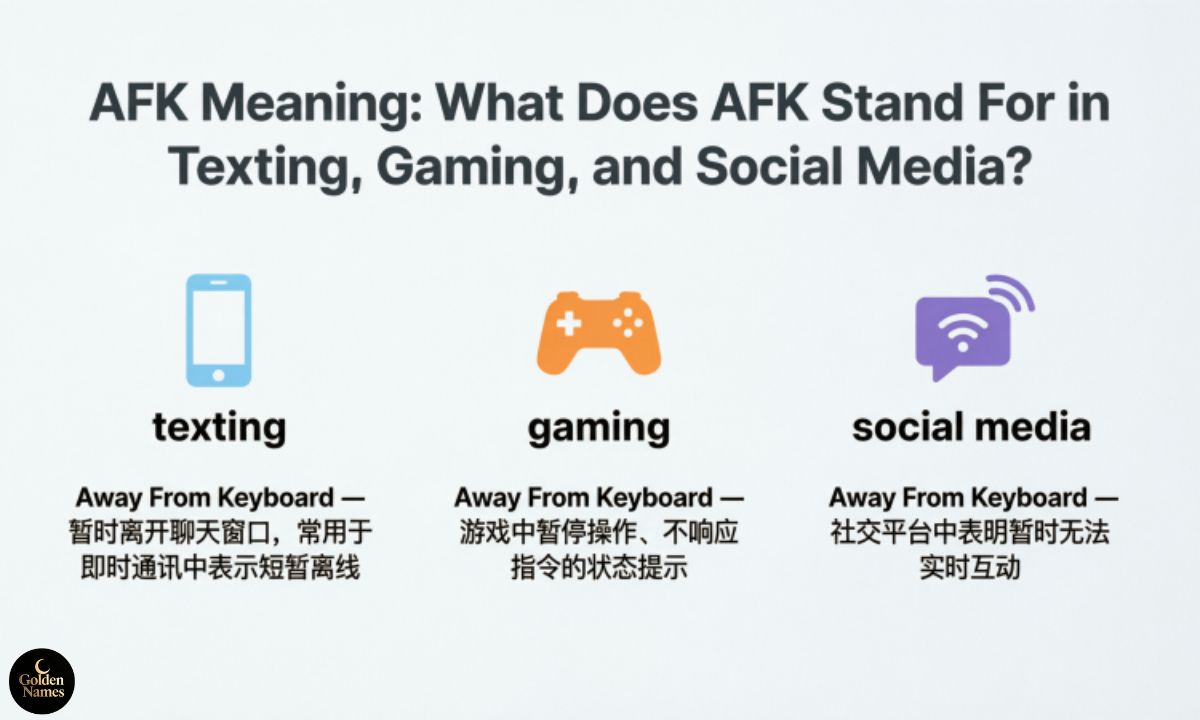
You’re mid-conversation in a Discord server, and someone types AFK before going quiet. Or maybe your kid dropped it casually at dinner, I told them I was AFK, so whatever. And you’re sitting there thinking, what exactly does that mean.
You’re not behind the times for asking. AFK is one of those internet terms that feels like it’s been around forever, because, honestly, it kind of has. But there’s a lot more to it than just a three-letter abbreviation. How it’s used, where it came from, when it’s totally appropriate versus when it’ll make you look out of place, all of that matters.
This guide covers everything. No fluff, no dictionary-style definitions with zero context. Just a real, thorough breakdown of what AFK means, where it shows up, and how to use it correctly in 2026.
What Does AFK Mean? The Simple Answer First
AFK stands for Away From Keyboard.
At its most basic level, it means someone has stepped away from their device and is temporarily unreachable. They’re not ignoring you. They’re just not at their screen right now.
That’s it. Simple enough. But of course, context changes everything, and AFK shows up in enough different situations that it’s worth unpacking each one.
What Is the Full Form of AFK?
The full form of AFK is Away From Keyboard. Every letter stands for a word: A for Away, F for From, K for Keyboard.
The original meaning was pretty literal. Back when AFK first appeared, people sat at desktop computers with physical keyboards. Stepping away from your keyboard actually meant getting up and walking away from the machine. Nobody else could send messages for you. You were just… gone.
Today that’s obviously changed. People communicate through phones, tablets, laptops, voice assistants, all kinds of devices. But the abbreviation stuck, and the meaning evolved with it.
Now AFK essentially means I am temporarily unavailable on whatever device I’m using. The keyboard part is more symbolic than practical.
Where Did AFK Come From? A Brief History of the Term
AFK didn’t appear in pop culture or on TV. It grew up quietly inside early internet communities specifically the chat rooms of the 1990s.
AFK Started in IRC Chat Rooms in the Early 1990s
If you weren’t online in the early nineties, IRC (Internet Relay Chat) might not mean much to you. But IRC was essentially the Discord of its era, a real-time text-based communication platform where people gathered in “channels” to talk about shared interests.
The problem with IRC was simple: if you walked away from your computer without saying anything, your friends or fellow chatters had no idea. They’d send you messages and wait. And wait some more. It wasn’t rude in any malicious sense, but it was disruptive to conversations.
So users invented a shorthand. Type AFK before you leave, and everyone in the channel knows you’ve stepped away. You’ll respond when you’re back.
This small piece of shorthand spread fast. By the mid-nineties, AFK was considered basic chat etiquette in online communities. It was one of the earliest examples of internet users creating their own unwritten social rules, a fascinating little piece of digital history.
From IRC to Online Gaming
The term moved naturally into online gaming communities as they exploded in the late nineties and early 2000s. Games like EverQuest and later World of Warcraft involved groups of players working together in real time. If one player went AFK without warning, the whole group suffered.
AFK became a critical communication tool. You said it before you stepped away, and your team knew to cover for you or wait a few minutes.
From there, it spread to virtually every corner of online communication.
AFK Meaning in Gaming: Why It’s More Than Just a Heads-Up
In casual texting, AFK is just a polite notice. In gaming, it carries real weight.
What AFK Means in Competitive and Team-Based Games
When you go AFK in a single-player game, the only person it affects is you. But in team-based multiplayer games, the kind most people play today, going AFK without any warning is a real problem.
Your character might keep standing in place, taking damage, blocking your teammates’ movement, or just doing nothing while the other team presses an advantage. Depending on the game, this can cost your team a match they were winning.
Here’s how AFK plays out across some of the biggest gaming platforms right now:
Roblox: In most Roblox games, an AFK character just stands frozen in place. On busy servers, the game will often auto-kick idle players after 20 minutes or so to free up space. In Roblox games with team objectives, an AFK player is effectively a missing teammate.
Free Fire: In ranked matches, going AFK is taken seriously by both the game’s systems and your squadmates. Your character becomes a stationary target, and your teammates are left to carry a man-down situation. Your personal rank points take a hit regardless of how the match ends.
Mobile Legends: Mobile Legends (ML) is one of the strictest games about AFK behavior. The game actively tracks how often players leave matches early or go idle. First-time offenders can receive queue bans of 5 to 10 minutes. Repeated behavior escalates to longer restrictions, credit score reductions, and in serious cases, permanent bans from ranked mode.
League of Legends: Riot Games has an entire system called Leaver Buster that monitors AFK and early-leave behavior. Players who trigger it face honor level reductions and restrictions on competitive queues. It’s designed specifically to protect other players from the impact of AFK teammates.
Valorant: Going AFK in a Valorant ranked match results in ranked rating penalties. Severe or repeated cases can suspend access to competitive play entirely.
The Right Way to Go AFK in a Game
You can’t always avoid stepping away mid-game. Life happens. Someone’s at the door, your kid needs something, your food is burning. It’s fine.
The move is simple: type “AFK” or “brb, AFK” in team chat before you put the controller down. It doesn’t prevent penalties in some games, but it does let your teammates know you’re not rage-quitting and that you’ll be back. It’s just considerate.
In voice chats on platforms like Discord, saying “hey, going AFK for a minute” works the same way. A little communication goes a long way.
AFK in Texting and Everyday Conversations
Not everyone who uses AFK is a gamer. The term has moved fully into everyday digital communication, especially among younger people.
How AFK Is Used in Text Messages and WhatsApp
In texting, AFK is a quick and easy way to let someone know you won’t be responding for a while, without leaving them to wonder why you’ve gone quiet.
A few real-world examples of how it shows up:
- Going AFK, heading to the gym. Back in about an hour.
- AFK for a bit, doctor’s appointment.
- Sorry I missed your messages, was AFK all morning.
- AFK, got company over. Talk later.
In group chats specifically, AFK is really useful. When a conversation is moving fast and you need to step away, a quick “AFK” tells the group you’re still there, just not actively watching the thread.
It saves you from the awkward situation of returning to a flood of messages where people weren’t sure if you’d seen anything.
AFK on Social Media: Instagram, TikTok, Discord, and Twitch
Live digital platforms have made AFK even more relevant than it’s ever been.
Twitch: Streamers go AFK during bathroom breaks, technical issues, or between gameplay sessions. Most experienced streamers set up an “AFK screen, a simple overlay with music and sometimes a countdown timer, so their audience knows they’ll be back. Typing “AFK brb” in stream chat is standard practice before going off-screen.
Discord: Discord has a built-in AFK channel feature. Server admins can designate a specific voice channel as the “AFK channel,” and Discord will automatically move users there after a set period of inactivity, usually 5 to 30 minutes depending on the server’s settings. This shows just how thoroughly AFK has worked its way into actual platform design, not just community slang.
TikTok Live and Instagram Live: Creators going live often drop “AFK brb” in their own comment section or on-screen text when they need a moment. It keeps the audience from leaving when the creator briefly steps away.
Twitter/X and Reddit: You’ll see AFK in comment threads, mostly in gaming or tech communities. Someone might say “went AFK for 20 minutes and missed the whole discussion to explain a delayed response.
AFK vs. BRB vs. GTG: What’s the Difference?
These three abbreviations all relate to someone leaving or being unavailable, but they’re not the same thing. Using the wrong one in the wrong situation can send a slightly different message than you intended.
| Abbreviation | Full Form | What It Signals | Typical Duration |
| AFK | Away From Keyboard | Stepping away, back eventually | Undefined, often longer |
| BRB | Be Right Back | Short break, back very soon | Under 5 minutes |
| GTG | Got To Go | Leaving the conversation for now | Done for a while or day |
AFK is the most open-ended. You’re stepping away, but you haven’t committed to when you’ll be back. It’s the honest choice when you’re not sure how long you’ll be gone.
BRB implies you’ll be back in a minute or two. Grabbing a drink, taking a quick call, answering the door. If you type BRB and then disappear for an hour, that’s a little inconsiderate.
GTG signals you’re done for now. The conversation is basically over from your end. You might catch up later.
In gaming specifically, AFK is almost always the right choice. It’s accurate and your teammates understand exactly what it means.
AFK Slang in Gen Z Culture: How the Meaning Has Expanded
Language evolves, and AFK is a good example of how internet slang can shift meaning over time without losing its core.
For older millennials and Gen X who grew up with early internet, AFK is a practical abbreviation. You use it when you step away, and that’s that.
For Gen Z, AFK has taken on a slightly broader cultural meaning. Some younger users say I went AFK” to describe stepping away from social media entirely, taking a break from being online, not just from a single device. It’s become shorthand for a digital detox, or just a needed break from the constant connectivity of modern life.
You might see a caption like “was AFK from Instagram for a week and honestly needed it. That’s not a technical use of the term. It’s cultural adoption, the word has moved from specific internet protocol into general life commentary.
Neither usage is wrong. Language grows.
AFK Pros, Cons, and When to Use It
When AFK Is Genuinely Useful
- Lets teammates or chat partners know you’re stepping away without being rude
- Prevents confusion about whether you’ve ignored someone or just haven’t seen their message
- Saves face in games by signaling you’re not rage-quitting
- Works across platforms, gaming, texting, Discord, anywhere informal
Where AFK Falls Short
- It’s vague, it doesn’t tell anyone how long you’ll be gone
- It can be misused as an excuse to dodge conversations
- In gaming, saying AFK doesn’t actually prevent penalties from the game’s systems
- It’s completely inappropriate in professional contexts (more on this below)
Common Mistakes People Make With AFK
Confusing AFK with BRB: If you’ll be back in 90 seconds, say BRB. AFK implies a longer, undefined absence. Using AFK when you mean BRB sets the wrong expectation.
Not saying anything at all: This is the bigger mistake. Especially in multiplayer games or active group chats, going quiet without any notice is more disruptive than the absence itself. AFK is there precisely to solve this, use it.
Using AFK in professional settings: If your manager messages you on Slack during a project crunch and you reply AFK, that’s going to land poorly. The workplace section below covers this in more detail.
Treating AFK as an excuse: Some players type AFK just to avoid accountability for leaving a match. Game systems have gotten smarter about this, they track idle status, not just whether someone typed AFK in chat.
Forgetting to say you’re back: Technically you don’t have to announce your return, but in slower-moving conversations, a quick back or brb over is a nice touch. It closes the loop.
Should You Use AFK at Work? The Professional Reality
AFK works in casual, informal settings. It doesn’t belong in professional communication, and the distinction matters more than most people think.
Casual Workplace Settings Where AFK Might Be Fine
If you’re on a Slack team with close colleagues, a startup culture, or a gaming-adjacent company, AFK might occasionally pop up without anyone batting an eye. Some distributed tech teams use it casually in team chat channels.
That said, this is the exception, not the rule.
Situations Where AFK Is Never Appropriate at Work
- Emails to clients, managers, or executives
- Out-of-office or away messages
- Customer support chats
- Formal announcements or meeting notes
- Any communication with someone unfamiliar with internet slang
Using AFK in a client email is like showing up to a presentation in pajamas. It’s not a disaster, but it signals that you didn’t quite read the room.
Better Professional Alternatives
If you need to let someone know you’re stepping away in a work context, use plain language:
- I’ll be away from my desk for the next hour and will follow up when I return.
- I’m in a meeting until 3 PM, I’ll respond as soon as I’m free.
- I need to step away briefly. Back shortly.
Most platforms have built-in tools for this. Slack lets you set a custom status (“In a meeting, Lunch break, etc.). Zoom shows you as Away when idle. Google Calendar blocks your time as Busy. These tools make AFK unnecessary in professional environments, and they communicate more clearly anyway.
AFK in Different Languages and Global Contexts
AFK has traveled far beyond English-speaking communities. Because online gaming is global, the abbreviation shows up in gaming communities in Brazil, Germany, South Korea, Japan, and across Southeast Asia, often used exactly as it is in English, because gaming vocabulary tends to cross language barriers through shared platforms.
In some countries, localized versions exist. But in most global gaming communities, AFK is understood regardless of native language. It’s one of those terms that became part of the internet’s shared vocabulary.
Frequently Asked Questions
What does AFK mean in texting
In texting, AFK means Away From Keyboard basically that someone has stepped away from their phone or device and won’t be responding for a bit. It’s a quick way to let someone know you’re not ignoring them, you’re just unavailable right now. You’ll see it used the same way you’d use brb or give me a few minutes.
What does AFK mean in gaming
In gaming, AFK means a player has stepped away from their device and their character is idle in the game. In multiplayer and team-based games, going AFK without telling your teammates can hurt your whole squad, and many games now have automated penalty systems for players who go AFK too often in ranked matches.
What does AFK mean in slang for Gen Z
Gen Z uses AFK both in its traditional sense and in a broader cultural sense. Some younger users say “going AFK” to mean they’re taking a full break from their phone or social media, a kind of informal digital detox. It’s also just part of everyday online vocabulary for Gen Z, who grew up in spaces like Discord and Roblox where AFK is standard language.
Is AFK rude
AFK itself is not rude at all, it’s actually the polite alternative to just disappearing without a word. The rude version is going silent without any notice. That said, AFK used in professional or formal settings can come across as inappropriate, since it’s informal internet slang. Context determines whether it lands well or awkwardly.
What’s the difference between AFK and offline
AFK means you’re technically still logged in or connected, your status might still show as online but you’re not actively at your device. Offline means you’ve disconnected entirely. Someone who is AFK might respond within minutes; someone who’s offline might not be reachable until they reconnect.
Why do kids use AFK so much
Kids spend a lot of time on platforms like Roblox, Fortnite, Discord, and TikTok, all of which have AFK as a built-in part of their culture and sometimes their actual features. So kids grow up using it the way older generations grew up saying “I’ll call you back.” It’s just the natural shorthand of the digital environments they inhabit.
Does AFK work as a full sentence
Yes in internet communication, AFK functions as a complete statement on its own. You can type it alone and people understand exactly what you mean. You can also pair it with other shorthand: AFK brb, going AFK, or back, was AFK.
Conclusion
AFK, Away From Keyboard, has been part of internet culture for over 30 years. It started as a practical solution to a simple problem in 1990s chat rooms, grew into an essential term in online gaming, and is now a natural part of how millions of people communicate online every day.
The core meaning has never really changed. AFK means “I’ve stepped away, I’m not available right now.” What has changed is the range of places it shows up, the platforms it lives on, and the slightly broader cultural meanings younger generations have attached to it.
Use it freely in gaming, Discord, group chats, and casual texting. Skip it in emails to your boss, client presentations, or any setting where the other person might not know what it means. And next time someone types AFK in your game lobby, you’ll know exactly what to expect.