

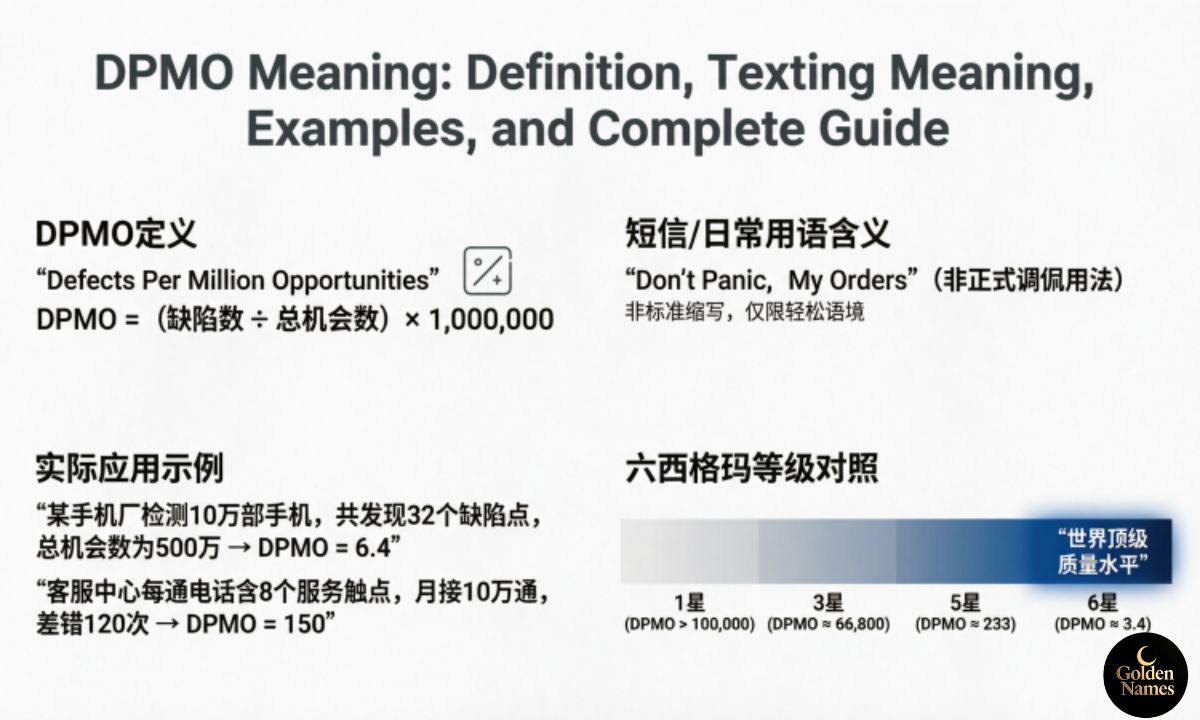
If you’ve come across the term DPMO, you might be wondering what it actually means. The answer depends entirely on where you saw it.
In business and quality management, DPMO stands for Defects Per Million Opportunities, a performance measurement used in Six Sigma and process improvement. In texting, social media, and online conversations, DPMO often means Don’t Piss Me Off, a slang expression used to show frustration or annoyance.
Because these two meanings are completely different, many people become confused when they encounter the acronym for the first time.
This guide explains the full DPMO meaning, how it is used in different situations, real-life examples, common mistakes people make, and when you should or should not use it. Whether you found DPMO in a quality report, a text message, TikTok comment, Instagram caption, or workplace discussion, you’ll find the answer here.
What Does DPMO Mean
DPMO has two widely recognized meanings:
| Meaning | Context |
| Defects Per Million Opportunities | Business, manufacturing, quality management, Six Sigma |
| Don’t Piss Me Off | Texting, social media, online chats |
The correct interpretation depends on the context.
For example:
Business Example
“Our production line reduced DPMO by 35 percent this quarter.”
Here, DPMO refers to a quality metric.
Text Message Example
“DPMO today. I’ve already had enough drama.
In this case, DPMO means “Don’t Piss Me Off.
Understanding the surrounding conversation usually makes the intended meaning obvious.
DPMO Meaning in Business
The most established meaning of DPMO is Defects Per Million Opportunities.
It is a quality measurement used to determine how many defects occur in a process compared to the total number of opportunities for those defects to happen.
Organizations use DPMO to:
- Measure process performance
- Identify quality issues
- Compare different processes
- Track improvement efforts
- Support Six Sigma initiatives
- Reduce waste and rework
- Improve customer satisfaction
Simple Definition
DPMO answers a simple question:
If a process had one million opportunities to fail, how many defects would occur?
The lower the DPMO, the better the process quality.
Breaking Down the Term DPMO
To understand DPMO, let’s examine each part.
Defects
A defect is any failure to meet a requirement.
Examples include:
- A scratched product
- A software bug
- Incorrect customer information
- Missing data in a form
- Shipping the wrong item
Opportunities
An opportunity is a chance for a defect to occur.
For example:
A customer order form may contain:
- Name field
- Address field
- Phone number field
- Email field
- Payment field
That creates five opportunities for errors.
Per Million
The result is scaled to one million opportunities.
This standardization makes it easier to compare different processes regardless of size.
DPMO Formula Explained
The standard formula is:
DPMO = (Defects ÷ (Units × Opportunities)) × 1,000,000
Where:
- Defects = total errors found
- Units = total items inspected
- Opportunities = possible defects per unit
Example Calculation
Imagine a company reviews:
- 1,000 forms
- 10 fields per form
- 25 errors discovered
Calculation:
DPMO = (25 ÷ (1,000 × 10)) × 1,000,000
DPMO = 2,500
This means there are 2,500 defects per million opportunities.
Why DPMO Matters
Many organizations rely on DPMO because it provides a fair measurement of quality.
Simply counting defects can be misleading.
Consider these examples:
Process A
- 100 defects
- 50,000 opportunities
Process B
- 100 defects
- 500,000 opportunities
Although both have the same number of defects, Process B actually performs much better because it had far more opportunities for mistakes.
DPMO reveals this difference.
Benefits include:
- Better decision-making
- Improved quality control
- Fair process comparisons
- Reduced operational costs
- Enhanced customer experience
DPMO and Six Sigma
DPMO is closely associated with Six Sigma methodology.
Six Sigma focuses on reducing variation and minimizing defects.
The famous Six Sigma benchmark corresponds to approximately:
3.4 defects per million opportunities
This level represents extremely high process quality.
Common Sigma Levels
| Sigma Level | Approximate DPMO |
| 2 Sigma | 308,537 |
| 3 Sigma | 66,807 |
| 4 Sigma | 6,210 |
| 5 Sigma | 233 |
| 6 Sigma | 3.4 |
As sigma performance improves, DPMO decreases.
Industries That Use DPMO
Many people assume DPMO is only used in manufacturing.
In reality, it appears across numerous industries.
Manufacturing
Used to monitor:
- Product defects
- Assembly errors
- Packaging issues
- Equipment performance
Healthcare
Used to measure:
- Medical record accuracy
- Medication errors
- Laboratory mistakes
- Administrative quality
Banking
Used to track:
- Data entry errors
- Application processing mistakes
- Compliance issues
Software Development
Used for:
- Bug tracking
- Quality assurance
- Testing performance
- Release management
Customer Service
Used to evaluate:
- Incorrect responses
- Resolution errors
- Service failures
DPMO Meaning in Texting
Outside business environments, DPMO usually means:
Don’t Piss Me Off
This is a slang expression used to communicate frustration, irritation, or a warning.
The phrase is common in:
- Text messages
- TikTok comments
- Instagram DMs
- Snapchat conversations
- Discord chats
- Gaming communities
- Online forums
How DPMO Is Used in Conversations
The meaning often depends on tone and context.
Serious Warning
DPMO. I’m already stressed.
The sender is expressing genuine frustration.
Playful Joke
Eat my fries again and DPMO.
This may be humorous between friends.
Setting Boundaries
DPMO today. I need some space.
The sender wants others to back off temporarily.
Examples of DPMO in Text Messages
Here are some common examples.
Example 1
Friend: I’m going to spoil the movie ending.
You: DPMO.
Example 2
Friend: You forgot my birthday.
You: DPMO right now.
Example 3
Sibling: I borrowed your charger.
You: You better return it. DPMO.
Example 4
Coworker: Another meeting was added.
You: DPMO. My calendar is already packed.
Is DPMO Rude
It can be.
Because the phrase contains profanity, some people may find it offensive.
The perceived tone depends on:
- Relationship between people
- Conversation context
- Cultural norms
- Communication style
Close friends may use it casually.
In professional settings, it can appear aggressive and inappropriate.
When You Should Not Use DPMO
Avoid using DPMO in:
- Work emails
- Professional meetings
- Customer service interactions
- School assignments
- Formal business communication
- Academic writing
More professional alternatives include:
- Please don’t test my patience.
- Let’s keep things respectful.
- I’m feeling frustrated.
- I’d rather not discuss that right now.
- Let’s move on from this topic.
How to Respond When Someone Says DPMO
Your response should match the situation.
If They Are Angry
Try:
- I understand.
- Let’s talk later.
- Sorry about that.
- I didn’t mean to upset you.
If They Are Joking
You might reply:
- Relax, I’m kidding.
- No promises.
- Fair enough.
Reading the emotional tone is important.
Common Misconceptions About DPMO
DPMO Always Means a Quality Metric
False.
Many younger internet users recognize DPMO as texting slang.
DPMO Is Always Angry
Not necessarily.
Sometimes it is playful or sarcastic.
DPMO Is Only Used in Manufacturing
Incorrect.
Healthcare, finance, software, logistics, and service industries all use DPMO.
DPMO Measures Perfect Quality
No.
Even low DPMO processes can still experience defects.
DPMO vs Other Quality Metrics
Understanding related terms helps clarify the business meaning.
DPMO vs DPO
DPO means Defects Per Opportunity.
DPMO simply scales DPO to one million opportunities.
DPMO vs DPU
DPU means Defects Per Unit.
DPU focuses on defects per item rather than opportunities.
DPMO vs PPM
PPM means Parts Per Million.
PPM measures defective units.
DPMO measures defect opportunities.
Because DPMO accounts for process complexity, it often provides a more accurate quality assessment.
Real-World Example of DPMO in Business
Imagine an online retailer processes 20,000 orders.
Each order contains:
- Customer name
- Address
- Payment information
- Product selection
- Shipping method
This creates five opportunities for errors.
Total opportunities:
20,000 × 5 = 100,000
If 120 errors occur:
DPMO = (120 ÷ 100,000) × 1,000,000
DPMO = 1,200
The company can use this metric to monitor quality improvements over time.
Real-World Example of DPMO in Social Media
Suppose someone posts:
Lost my wallet, missed my train, and spilled coffee on my shirt. DPMO today.
The person is expressing frustration and asking others not to make their day worse.
No business meaning is involved.
Context makes the interpretation clear.
Pros and Cons of Using DPMO
Pros
Business Meaning
- Standardized metric
- Supports quality improvement
- Enables fair comparisons
- Useful for benchmarking
- Widely recognized
Slang Meaning
- Quick communication
- Expresses emotion clearly
- Popular online
- Easy to understand among peers
Cons
Business Meaning
- Can be misunderstood by beginners
- Requires accurate opportunity counts
- May not reflect defect severity
Slang Meaning
- Can sound aggressive
- Includes profanity
- Unsuitable for professional settings
- Easily misinterpreted
Frequently Asked Questions
What does DPMO stand for
DPMO can mean either Defects Per Million Opportunities or Don’t Piss Me Off depending on context.
What is DPMO in Six Sigma
DPMO is a quality measurement used to evaluate defects relative to total opportunities for defects.
What does DPMO mean in texting
In texting, DPMO usually means “Don’t Piss Me Off.
Is DPMO a bad word
The acronym itself is not offensive, but the phrase behind the texting meaning contains profanity.
How do you calculate DPMO
Use this formula:
DPMO = (Defects ÷ (Units × Opportunities)) × 1,000,000
Is DPMO still used today
Yes. Businesses continue using DPMO for quality management, while online users commonly use it as texting slang.
Is DPMO used on TikTok and Instagram
Yes. The slang meaning frequently appears in comments, captions, direct messages, and social media conversations.
Can DPMO have more than two meanings
Although other niche interpretations exist, the two dominant meanings are Defects Per Million Opportunities and Don’t Piss Me Off.
Conclusion
DPMO is one of those acronyms that carries completely different meanings depending on where you encounter it. In business, manufacturing, healthcare, and Six Sigma programs, DPMO stands for Defects Per Million Opportunities and serves as an important quality measurement tool. It helps organizations identify problems, improve processes, and reduce errors.
In texting, social media, and online conversations, DPMO usually means Don’t Piss Me Off. It acts as a warning, expression of frustration, or sometimes a playful remark among friends.
Whenever you see DPMO, look at the surrounding context first. A quality report and a TikTok comment are speaking entirely different languages, even when they use the exact same four letters. Understanding both meanings ensures you interpret the acronym correctly and avoid unnecessary confusion.