

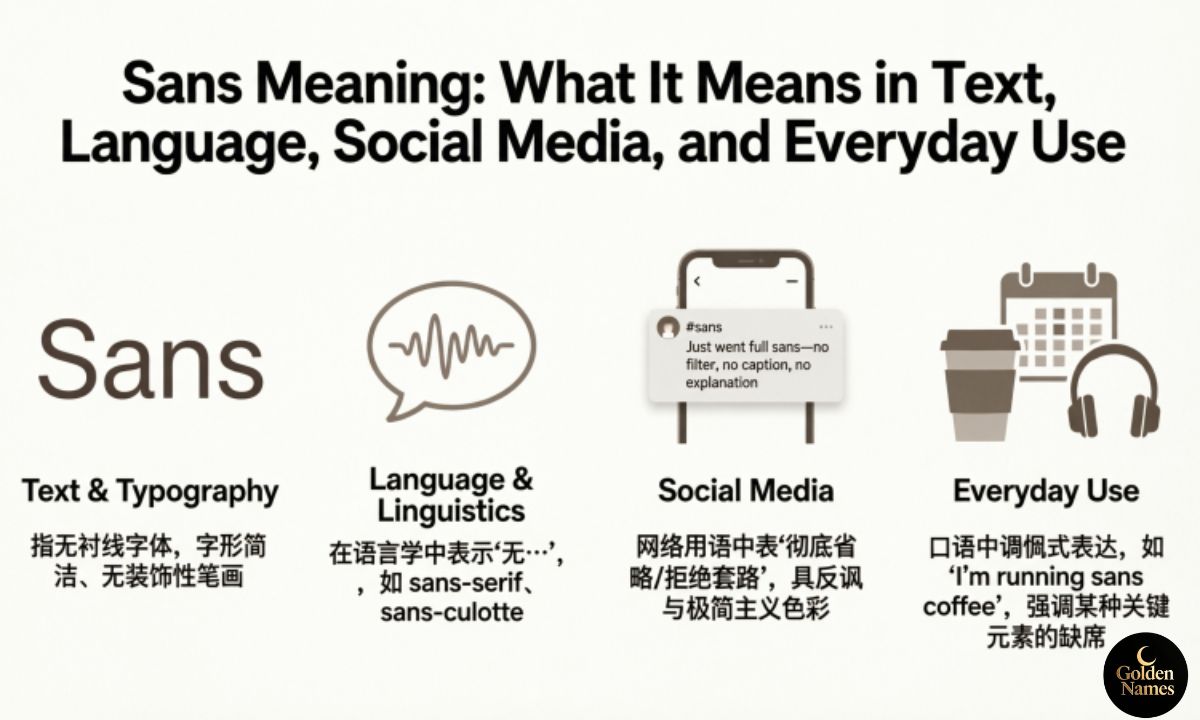
If you have come across the word “sans” in a text message, social media post, book, conversation, or online discussion, you may have wondered what it actually means. While the word looks simple, it can carry different meanings depending on the context.
In most situations, sans means without. It is a borrowed word from French that has become a common part of English vocabulary. People use it in writing, texting, social media captions, professional communication, and even branding.
For example, someone might say:
- Coffee sans sugar
- A vacation sans stress
- Working sans internet
In each case, the word simply means that something is missing or absent.
However, there is more to understand about this term. Its origin, modern usage, role in digital communication, and common misconceptions often confuse readers. This guide explains everything you need to know about the meaning of sans, including examples, social media use, texting interpretations, and practical tips for using it correctly.
What Does Sans Mean
The word sans means without.
It is commonly used to describe the absence of something.
Simple Definition
| Word | Meaning |
| Sans | Without |
| Absent | Missing |
| Lacking | Not having something |
| Devoid of | Completely without |
Examples
- She ordered a burger sans cheese.
- The room looked beautiful sans decorations.
- We completed the project sans additional funding.
- He attended the event sans his usual team.
In each sentence, replacing “sans” with “without” would create the same meaning.
Origin of the Word Sans
The term comes from the French language. In French, “sans” directly translates to “without.”
English speakers adopted the word centuries ago, especially in literary and formal writing. Over time, it became widely accepted in everyday communication.
Today, it appears in:
- Books
- Magazines
- Newspapers
- Text messages
- Social media posts
- Marketing campaigns
- Business communication
Although it originated in French, modern English speakers often use it naturally without thinking about its foreign roots.
Why Do People Use Sans Instead of Without
Many people wonder why someone would choose “sans” when “without” already exists.
The answer is usually style, brevity, or tone.
It Sounds More Sophisticated
Some writers use the word because it sounds polished or elegant.
Example:
- The room was decorated sans clutter.
Compared to:
- The room was decorated without clutter.
Both are correct, but the first version may feel more stylish.
It Is Shorter
In captions, headlines, and short messages, fewer words can make communication cleaner.
Example:
- Weekend vibes sans work.
It Creates a Casual Tone
Social media users often choose “sans” because it feels conversational and trendy.
Example:
- Living life sans drama.
Sans Meaning in Text Messages
In texting, the meaning remains the same.
When someone uses sans in a text message, they are almost always saying without.
Common Texting Examples
- Going to dinner sans the kids.
- Watching the movie sans spoilers.
- Arrived sans luggage.
- Coffee run sans caffeine today.
How People Interpret It
Most readers understand the intended meaning immediately because the surrounding words provide context.
For example:
Heading to the beach sans sunscreen.
The reader can easily understand that the person is going to the beach without sunscreen.
Sans Meaning on Social Media
Social media platforms have helped popularize the word among younger audiences.
You may see it frequently on:
- TikTok
- X
- Threads
Popular Caption Examples
- Vacation sans worries.
- Weekend sans deadlines.
- Living sans negativity.
- Date night sans phones.
Creators often use the term because it is short, visually appealing, and easy to understand.
Why Influencers Use It
Influencers and content creators often aim for concise captions.
Instead of writing:
Enjoying life without stress.
They may write:
Enjoying life sans stress.
The shorter format works well for modern content.
Common Uses of Sans in Everyday Language
The word appears in many real-world situations.
Food and Restaurants
Restaurants frequently use the term to describe omitted ingredients.
Examples:
- Pizza sans onions
- Salad sans dressing
- Burger sans pickles
Fashion
Fashion writers often use it when describing styles.
Examples:
- A minimalist look sans accessories
- Casual attire sans a jacket
Business Communication
Professionals sometimes use it in emails or reports.
Examples:
- The meeting proceeded sans technical issues.
- The proposal was submitted sans revisions.
Entertainment and Media
Journalists and reviewers frequently use the word.
Examples:
- A sequel sans the original cast.
- A concert sans live instruments.
Is Sans Formal or Informal
One interesting aspect of the word is its flexibility.
Formal Contexts
It can appear in:
- Academic writing
- Journalism
- Professional reports
- Editorial content
Example:
The study was conducted sans external funding.
Informal Contexts
It is equally common in casual conversations.
Example:
I showed up sans my wallet.
Best Description
The word is generally considered neutral, meaning it can fit both formal and informal situations when used appropriately.
Examples of Sans in Different Sentences
Seeing the word in context makes it easier to understand.
Personal Life
- We traveled sans a detailed itinerary.
- She arrived sans makeup.
- They moved forward sans hesitation.
School and Education
- The assignment was completed sans assistance.
- Students attended class sans textbooks.
Work and Career
- The presentation ran smoothly sans interruptions.
- The company expanded sans outside investors.
Travel
- We explored the city sans a tour guide.
- The trip continued sans delays.
Common Phrases Using Sans
Several expressions regularly appear in writing and conversation.
Sans Limits
Meaning without restrictions.
Example:
- Creativity flourishes sans limits.
Sans Fear
Meaning without fear.
Example:
- He spoke openly sans fear.
Sans Borders
Meaning without boundaries.
Example:
- A community connected sans borders.
Sans Excuses
Meaning without excuses.
Example:
- Success requires effort sans excuses.
What Does Sans Mean in Pop Culture
The word gained additional attention through popular culture, gaming communities, and internet discussions.
One notable example is the fictional character:
Sans
This character from the video game Undertale introduced many younger internet users to the word “sans.”
However, the character’s name and the dictionary definition are separate concepts.
The character is simply named Sans, while the word itself continues to mean without.
Sans in Typography
Another well-known use appears in typography.
What Does Sans Serif Mean
A sans serif font is a font without decorative finishing strokes called serifs.
Examples include:
- Arial
- Helvetica
- Calibri
- Verdana
Here, sans literally means without.
So:
- Serif = decorative stroke
- Sans serif = without decorative stroke
This is one of the most common technical uses of the term.
Difference Between Sans and Without
Many people ask whether there is any difference.
Meaning
The meaning is identical.
| Sans | Without |
| Same meaning | Same meaning |
| Slightly stylish | More common |
| Often shorter | More conversational |
| Sometimes literary | Everyday usage |
Examples
Sans:
- She arrived sans umbrella.
Without:
- She arrived without an umbrella.
Both sentences are grammatically correct.
The difference is primarily tone and style.
Advantages of Using Sans
1. Concise Communication
The word is shorter than “without.”
2. Stylish Expression
Many writers feel it adds elegance.
3. Social Media Friendly
It fits naturally into short captions.
4. Widely Understood
Most English speakers recognize its meaning.
Disadvantages of Using Sans
1. Can Sound Pretentious
Some readers may perceive excessive use as overly formal.
2. Not Always Suitable
Certain business documents benefit from clearer, simpler language.
3. May Confuse Some Readers
Although common, not everyone immediately understands the term.
4. Overuse Can Feel Forced
Using it repeatedly may make writing seem unnatural.
Common Mistakes People Make
Thinking Sans Has Multiple Hidden Meanings
Most of the time, it simply means without.
Assuming It Is Slang
The word is not internet slang. It is a legitimate English word with French origins.
Confusing It With a Character Name
Some people first encounter the word through gaming culture and assume every use refers to the fictional character.
Using It Excessively
Balance is important. Sometimes “without” is the clearer choice.
When Should You Use Sans
Consider using the word when:
- Writing social media captions
- Creating headlines
- Adding stylistic variety
- Seeking concise wording
- Writing lifestyle content
You may want to avoid it when:
- Writing for audiences unfamiliar with the term
- Creating highly technical instructions
- Drafting legal documents requiring maximum clarity
Real-Life Examples of Sans Usage
Example 1: Restaurant Order
A customer orders:
Can I have the sandwich sans tomatoes
Meaning:
The sandwich should be prepared without tomatoes.
Example 2: Travel Post
A traveler writes:
“Exploring Europe sans a strict schedule”
Meaning:
Traveling without a fixed plan.
Example 3: Workplace Email
An employee writes:
The project was completed sans additional resources.
Meaning:
The project was completed without extra resources.
Example 4: Social Media Caption
Weekend coffee sans alarms.
Meaning:
Enjoying coffee without early wake-up calls.
Frequently Asked Questions
Is sans a real English word
Yes. Although it originated in French, it is widely accepted and commonly used in English.
What does sans mean in texting
In texting, sans means without.
Example:
Going shopping sans my friends.
Is sans slang
No. It is a standard dictionary word rather than internet slang.
What does sans mean on Instagram
It usually means without and is often used in captions to create a concise style.
Can I replace sans with without
Yes. In most situations, the two words are interchangeable.
Is sans formal
It can be formal or informal depending on the context.
What does sans serif mean
Sans serif means without serifs, referring to a font style that lacks decorative strokes.
Why do people use sans
People often choose it because it is shorter, stylish, and easy to use in writing and social media.
Conclusion
The meaning of sans is straightforward: it means without. Despite its French origin, the word has become a natural part of modern English and appears in everything from professional writing to casual text messages and social media captions.
Its popularity comes from its simplicity. One small word can communicate the absence of something clearly and efficiently. Whether you see it in a restaurant order, a business report, an Instagram caption, or a typography discussion, the core meaning remains the same.
Understanding how and when to use sans helps you interpret conversations more accurately and communicate with greater confidence. While “without” remains the more common choice, “sans” offers a concise and stylish alternative that continues to thrive in both traditional and digital communication.