

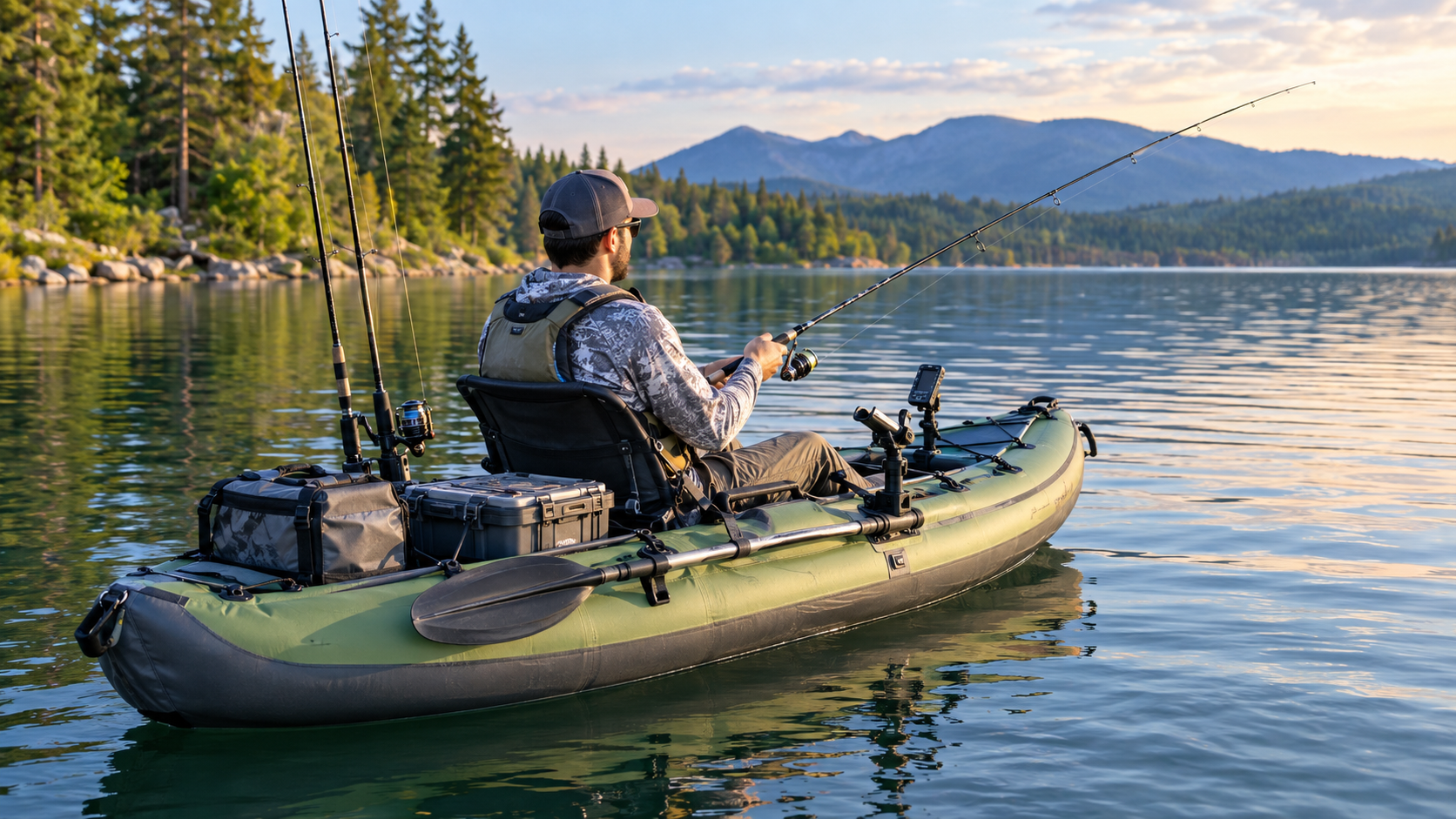
An inflatable fishing kayak offers a practical way to enjoy kayak fishing without needing the storage space or transportation setup required by many hard-shell kayaks. Modern inflatable kayaks can be packed into a bag, transported in a car, and inflated when you reach the water. For anglers who fish on lakes, calm rivers, and other suitable waterways, this portability can make kayak fishing much easier.
However, choosing the right inflatable fishing kayak involves more than looking at size or price. Stability, weight capacity, construction, inflation time, seating, storage, tracking, fishing accessories, and intended water conditions all matter. Safety is equally important because an inflatable kayak has limitations and should be used according to its design and the conditions on the water.
This guide explains what to look for, how inflatable fishing kayaks compare with traditional kayaks, their advantages and disadvantages, and how to use and maintain one properly.
What Is an Inflatable Fishing Kayak?
An inflatable fishing kayak is a kayak made from flexible, air-filled chambers rather than a rigid hull. It is specifically designed or equipped for fishing and may include features such as adjustable seats, rod holders, gear storage, mounting points, and multiple air chambers.
Unlike a traditional hard-shell kayak, an inflatable model can usually be deflated and packed for transportation and storage.
The main idea is simple:
- Transport the deflated kayak.
- Inflate it at the launch point.
- Attach the seat, accessories, and other equipment.
- Check the air chambers and fittings.
- Launch and begin fishing.
- Deflate, dry, fold, and store it after use.
The exact setup varies between models, so the manufacturer’s instructions should always take priority.
Why Choose an Inflatable Fishing Kayak?
The biggest attraction is portability.
A hard-shell fishing kayak can be difficult to transport without a suitable vehicle, roof rack, or trailer. An inflatable fishing kayak can often be carried in a storage bag and transported in the trunk or cargo area of a vehicle.
Key benefits
- Easy transportation: Deflated kayaks are much easier to move than rigid kayaks.
- Compact storage: They require considerably less storage space when deflated.
- Convenient for anglers: Many models include fishing-specific accessories.
- Useful for beginners: Some designs provide a stable platform for recreational fishing.
- Versatile transportation: They can be useful for anglers who do not own a large vehicle.
- Launch flexibility: Carrying the kayak to the water can be easier in locations without convenient vehicle access.
These advantages make inflatable kayaks particularly appealing to casual anglers, travelers, and people with limited storage space.
Important Features to Look For
Not every inflatable kayak is designed for the same purpose. Before buying one, consider how and where you intend to fish.
1. Stability
Stability is one of the most important characteristics for fishing.
Anglers frequently move their upper body, cast, retrieve fish, organize tackle, and reach for equipment. A kayak that feels excessively unstable can make these activities uncomfortable.
Look for a design intended for fishing rather than assuming every recreational inflatable kayak will provide the same experience.
2. Weight Capacity
Always check the manufacturer’s stated weight capacity.
Remember that your total load can include:
- Your body weight
- Fishing rods
- Tackle
- Cooler
- Food and water
- Safety equipment
- Electronics
- Anchor or other accessories
A kayak should not be selected based only on your body weight. The complete load matters.
3. Construction and Durability
Inflatable kayaks use different materials and construction methods. The material and construction affect durability, weight, resistance to abrasion, and overall performance.
Pay attention to:
- Reinforced areas
- Seams
- Multiple air chambers
- Protective outer layers
- Floor construction
- Valve quality
- Manufacturer maintenance instructions
A kayak intended for fishing should be suitable for the environment where you plan to use it.
4. Seating
A comfortable, adjustable seat can make a major difference during longer fishing sessions.
Consider:
- Back support
- Seat height
- Adjustability
- Cushioning
- Ease of installation
- Stability while casting
A higher seat can sometimes make fishing more comfortable, but stability should remain a priority.
5. Fishing Accessories
Fishing-focused inflatable kayaks may include useful features such as:
- Rod holders
- Paddle holders
- Gear attachment points
- Storage compartments
- D-rings
- Mounting points
- Removable skegs or tracking components
- Fishing-specific seating systems
Accessories are useful, but they should not replace the fundamentals of a suitable hull design and safe load capacity.
Inflatable Fishing Kayak vs. Hard-Shell Kayak
Both designs have advantages. The better choice depends on your priorities.
| Feature | Inflatable Fishing Kayak | Hard-Shell Fishing Kayak |
|---|---|---|
| Transportation | Very convenient when deflated | Often requires larger vehicle or rack |
| Storage | Compact when deflated | Requires dedicated storage space |
| Setup | Requires inflation | Usually ready to launch |
| Portability | Generally excellent | Can be difficult to carry |
| Puncture concern | Needs protection from sharp objects | Rigid hull does not have inflatable chambers |
| Fishing accessories | Available on many models | Widely available |
| Performance | Varies by design | Often more consistent across conditions |
| Best for | Portability and compact storage | Frequent use and rigid-hull performance |
There is no universal winner. Someone living in a small apartment may value portability more than someone who has a garage and regularly fishes from a dedicated kayak.
Best Water Conditions for an Inflatable Fishing Kayak
One of the most important questions is where you can safely use it.
Generally, many inflatable recreational and fishing kayaks are best suited to conditions appropriate for their specific design and certification. Calm lakes, protected waterways, and suitable slow-moving rivers may be appropriate for some models.
However, conditions can change quickly.
Before launching, consider:
- Wind
- Waves
- Current
- Water temperature
- Weather forecast
- Distance from shore
- Boat traffic
- Your experience
- The kayak’s intended use and manufacturer guidance
An inflatable fishing kayak should not automatically be treated as suitable for rough open water simply because it floats.
Avoid exceeding the kayak’s intended conditions
Strong wind can make paddling difficult, while waves and currents can create additional risks. If conditions are beyond your skill level or the kayak’s intended operating environment, postponing the trip is the safer choice.
How Stable Is an Inflatable Fishing Kayak?
A well-designed inflatable fishing kayak can be quite stable, but stability varies significantly between models.
Width, hull shape, floor design, seating position, weight distribution, and inflation can all influence how stable a kayak feels.
For fishing, stability is particularly important because you may need to cast repeatedly and handle equipment while sitting in one position.
Tips for improving stability
- Inflate the kayak according to the manufacturer’s instructions.
- Distribute equipment evenly.
- Keep heavier equipment low and centered.
- Avoid unnecessary movement.
- Learn how the kayak responds before fishing far from shore.
- Practice entering and exiting in shallow, controlled conditions.
Do not intentionally overload the kayak to make it feel more stable. Staying within its rated capacity is more important.
How to Choose the Right Inflatable Fishing Kayak
Choosing becomes easier if you start with your fishing style rather than the brand.
For occasional lake fishing
A compact recreational fishing kayak may be enough if you mainly fish calm water and carry relatively little equipment.
Prioritize:
- Easy inflation
- Compact storage
- Stable design
- Comfortable seat
- Adequate load capacity
For regular fishing trips
Frequent anglers may benefit from a more specialized design with better storage and fishing-specific attachment points.
Consider:
- Durable construction
- Adjustable seating
- Rod holders
- Larger storage areas
- Better tracking
- Multiple air chambers
- A practical inflation and deflation system
For traveling anglers
Portability becomes the main consideration.
Look for a model that can be transported easily along with your fishing equipment. Pay attention to the packed size and total carrying weight rather than only the inflated dimensions.
Inflatable Fishing Kayak Features at a Glance
| Feature | Why It Matters | What to Check |
|---|---|---|
| Weight capacity | Determines how much equipment you can carry | Total load rating |
| Width | Influences stability | Fishing-oriented hull design |
| Air chambers | Adds redundancy | Number and layout |
| Seat | Affects comfort and control | Adjustability and support |
| Storage | Keeps tackle accessible | Compartments and attachment points |
| Rod holders | Makes fishing more convenient | Position and number |
| Floor | Influences rigidity and comfort | Construction and support |
| Tracking system | Helps maintain direction | Skeg or hull design |
| Packed size | Important for transport | Bag dimensions |
| Inflation system | Affects setup time | Compatible pump and valves |
How to Set Up an Inflatable Fishing Kayak
Setup should be straightforward, but rushing can lead to mistakes.
Step 1: Choose a suitable launch area
Select a clean area without sharp rocks, broken glass, exposed metal, or other objects that could damage the kayak.
Step 2: Unpack and inspect it
Lay the kayak flat and check the material, seams, valves, and chambers for obvious damage.
Step 3: Inflate the chambers
Use the recommended pump and follow the manufacturer’s inflation instructions.
Do not guess the required pressure if the manufacturer provides a specific pressure rating.
Step 4: Install the seat
Secure the seat and adjust it so you can paddle comfortably while maintaining good control.
Step 5: Attach accessories
Install your fishing equipment, rod holders, paddle, and other accessories.
Step 6: Organize your gear
Keep essential equipment secure and distribute weight appropriately.
Step 7: Perform a final safety check
Before entering the water, confirm that:
- Chambers are properly inflated.
- Valves are closed.
- Seat is secure.
- Equipment is attached or secured.
- Nothing sharp is contacting the kayak.
- Your personal flotation device is properly worn.
What Should You Take Fishing in an Inflatable Kayak?
Avoid carrying unnecessary equipment. A kayak becomes harder to manage as the load increases.
A practical setup can include:
- Paddle
- Properly fitted personal flotation device
- Fishing rod and tackle
- Small tackle box
- Water
- Food or snacks
- Sun protection
- Basic first-aid supplies
- Phone or communication device in a suitable waterproof container
- Required fishing equipment
- Appropriate safety equipment
The exact equipment depends on your location, fishing method, weather, and local regulations.
Inflatable Fishing Kayak Safety Tips
Safety should come before fishing performance.
Always wear a personal flotation device
A properly fitted personal flotation device is one of the most important pieces of kayaking safety equipment.
Check the weather
Do not rely solely on conditions at the moment you leave home. Wind and weather can change.
Tell someone about your plans
For trips away from populated areas, let someone know where you are going and approximately when you expect to return.
Keep your load controlled
Never exceed the manufacturer’s capacity.
Protect the kayak from sharp objects
Although inflatable kayaks are designed for practical use, they can still be damaged by sharp objects. Use care when launching, landing, transporting, and handling fishing equipment.
Learn basic paddling skills
Before combining paddling with fishing, become comfortable controlling the kayak.
Practice:
- Forward strokes
- Turning
- Stopping
- Backward movement
- Launching
- Landing
- Recovering from unexpected movement
Common Mistakes to Avoid
Buying an inflatable fishing kayak without considering the intended environment is one of the most common mistakes.
Mistake 1: Choosing only by price
The cheapest kayak may not provide the features, durability, capacity, or design you actually need.
Mistake 2: Ignoring packed size
A kayak can be compact when deflated, but the complete package may still be substantial. Check the packed dimensions before purchasing.
Mistake 3: Forgetting equipment weight
Your tackle and accessories count toward the total load.
Mistake 4: Poor weight distribution
Concentrating heavy equipment in one area can affect handling.
Mistake 5: Incorrect inflation
Underinflation or incorrect inflation can affect performance. Follow the manufacturer’s instructions.
Mistake 6: Storing it while wet
Moisture left on the kayak can contribute to unpleasant odors, mildew, or material problems. Follow the manufacturer’s cleaning and storage recommendations.
Mistake 7: Fishing beyond your skill level
A calm-water kayak fishing trip can become difficult when wind, waves, or current increase. Build experience gradually.
How to Maintain an Inflatable Fishing Kayak
Proper maintenance can help keep your kayak in good condition.
After each trip
- Remove fishing equipment.
- Rinse the kayak when appropriate, particularly after exposure to saltwater.
- Clean away dirt and debris.
- Allow it to dry thoroughly.
- Inspect seams, valves, and surfaces.
- Deflate it according to the manufacturer’s instructions.
- Fold and store it properly.
Avoid using harsh chemicals unless the manufacturer specifically recommends them.
Before your next trip
Check for:
- Small leaks
- Damaged valves
- Worn seams
- Abrasion
- Damaged straps
- Missing fittings
- Problems with the seat or accessories
Finding a problem at home is much better than discovering it at the water.
How Long Does an Inflatable Fishing Kayak Take to Inflate?
Inflation time varies by kayak design, pump, air-chamber configuration, and the person doing the setup.
Rather than relying on a universal time estimate, check the manufacturer’s instructions for the specific model.
A quality pump compatible with the kayak can make setup considerably easier. Practicing the process at home before your first fishing trip is also useful.
Can You Stand Up in an Inflatable Fishing Kayak?
Only if the specific kayak is designed and marketed for standing use and you have practiced doing so safely.
Standing changes your center of gravity and can make a kayak less stable. A kayak that feels stable while seated should not automatically be assumed to be safe for standing.
If standing is important to your fishing style, choose a model specifically designed for that purpose and follow its instructions.
Are Inflatable Fishing Kayaks Worth It?
For many anglers, yes—particularly when portability and storage are major priorities.
An inflatable fishing kayak can be a good choice if you:
- Have limited storage space
- Need to transport the kayak in a normal vehicle
- Fish primarily in appropriate calm-water environments
- Want a portable fishing platform
- Prefer easier carrying and transportation
A hard-shell kayak may make more sense if you frequently fish, have suitable storage and transportation, and prioritize the characteristics of a rigid hull.
The best choice depends on your fishing location, frequency, equipment load, experience, and transportation needs.
Inflatable Fishing Kayak Buying Checklist
Before purchasing, ask these questions:
- Is the kayak designed specifically for fishing?
- What is its maximum weight capacity?
- How much does the complete package weigh?
- What is the packed size?
- How many air chambers does it have?
- What material is used?
- Is the seat adjustable?
- Does it include rod holders?
- Does it have useful storage?
- What type of water is it intended for?
- What pump is recommended?
- Are replacement parts available?
- What maintenance does the manufacturer recommend?
- Can I transport and store it easily?
If you can answer these questions confidently, you are much more likely to select a kayak that matches your actual needs.
Frequently Asked Questions
Is an inflatable fishing kayak good for beginners?
Yes. An inflatable fishing kayak can be suitable for beginners, especially when used in appropriate calm-water conditions. Beginners should learn basic paddling and safety skills before fishing in challenging environments.
Are inflatable kayaks safe for fishing?
They can be safe when used correctly and within their design limitations. Wear a properly fitted personal flotation device, stay within the weight capacity, inspect the kayak, and avoid conditions beyond your skill level or the kayak’s intended use.
Do inflatable kayaks puncture easily?
Inflatable kayaks can be damaged by sharp objects, but construction quality varies. Proper handling, careful launching, and following the manufacturer’s maintenance instructions can reduce the risk of damage.
Can you fish standing up from an inflatable kayak?
Some inflatable fishing kayaks are designed to support standing, while others are intended primarily for seated use. Always check the specific manufacturer’s guidance before attempting to stand.
What is the biggest advantage of an inflatable fishing kayak?
Portability is one of its biggest advantages. When deflated, it can be much easier to transport and store than a rigid kayak.
How do you clean an inflatable fishing kayak?
Remove dirt and fishing debris, rinse it when appropriate, and allow it to dry thoroughly before storage. Follow the manufacturer’s cleaning instructions and avoid products that could damage the material.
Can an inflatable fishing kayak be used in the ocean?
It depends on the specific kayak, its design, the local conditions, and the manufacturer’s intended-use guidance. Ocean conditions can change quickly, so a kayak suitable for calm inland water should not automatically be considered suitable for offshore use.
How much weight can an inflatable fishing kayak hold?
The capacity varies by model. Always check the manufacturer’s stated maximum capacity and include your body weight plus fishing equipment and other cargo when calculating the total load.
Final Thoughts
An inflatable fishing kayak can make kayak fishing more accessible by combining a portable design with fishing-oriented features. Its compact storage and convenient transportation are particularly valuable for anglers who do not have room for a hard-shell kayak.
The right choice, however, depends on more than portability. Stability, construction, weight capacity, seating, storage, water conditions, and safety features should all be considered before buying.
For beginners, the smartest approach is to choose a kayak suited to the waters they actually plan to fish, stay within the manufacturer’s limits, learn basic paddling skills, and prioritize safety over convenience. With the right setup and responsible use, an inflatable kayak can be a practical and enjoyable way to spend time on the water.